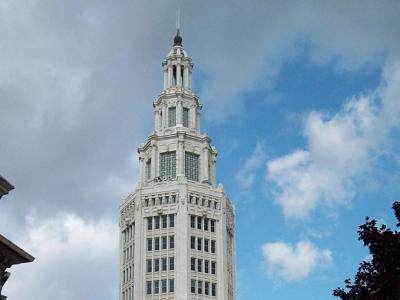


Electric Tower, Buffalo
The Electric Tower, also known as the General Electric Tower or Iskalo Electric Tower, is one of Buffalo’s most iconic landmarks, rising 294 feet above the city at the corner of Washington and Genesee Streets. Completed in 1912 and designed by local architect James A. Johnson of Esenwein & Johnson, the building reflects the Beaux-Arts Classical Revival style and was inspired by the Tower of Light from the 1901 Pan-American Exposition. Its octagonal shape, white terra-cotta façade, and tiered setbacks crowned by a glowing lantern make it a standout in Buffalo’s skyline.
Originally constructed as the Niagara Mohawk Building, the Electric Tower has been expanded several times, notably in 1923 and 1928. The architectural detailing includes early symbolic references to electricity, which are now seen as precursors to the Art Deco style that would soon flourish.
Beyond its architectural merits, the building plays a central role in Buffalo’s cultural life. Each year, it hosts the city's famed New Year’s Eve Ball Drop-one of the largest in North America outside New York City-drawing thousands to Roosevelt Plaza for live music and fireworks. At night, the tower’s spire is often lit in festive colors, including blue and gold to support the Buffalo Sabres during NHL playoff season.
Listed on the National Register of Historic Places in 2008, the Electric Tower continues to serve as both a working office building and a symbol of Buffalo’s historic and civic identity.
Originally constructed as the Niagara Mohawk Building, the Electric Tower has been expanded several times, notably in 1923 and 1928. The architectural detailing includes early symbolic references to electricity, which are now seen as precursors to the Art Deco style that would soon flourish.
Beyond its architectural merits, the building plays a central role in Buffalo’s cultural life. Each year, it hosts the city's famed New Year’s Eve Ball Drop-one of the largest in North America outside New York City-drawing thousands to Roosevelt Plaza for live music and fireworks. At night, the tower’s spire is often lit in festive colors, including blue and gold to support the Buffalo Sabres during NHL playoff season.
Listed on the National Register of Historic Places in 2008, the Electric Tower continues to serve as both a working office building and a symbol of Buffalo’s historic and civic identity.
Want to visit this sight? Check out these Self-Guided Walking Tours in Buffalo. Alternatively, you can download the mobile app "GPSmyCity: Walks in 1K+ Cities" from Apple App Store or Google Play Store. The app turns your mobile device to a personal tour guide and it works offline, so no data plan is needed when traveling abroad.
Download The GPSmyCity App


Electric Tower on Map
Sight Name: Electric Tower
Sight Location: Buffalo, USA (See walking tours in Buffalo)
Sight Type: Attraction/Landmark
Sight Location: Buffalo, USA (See walking tours in Buffalo)
Sight Type: Attraction/Landmark
Walking Tours in Buffalo, New York

Create Your Own Walk in Buffalo
Creating your own self-guided walk in Buffalo is easy and fun. Choose the city attractions that you want to see and a walk route map will be created just for you. You can even set your hotel as the start point of the walk.

Buffalo's Historical Churches
Be it for the British and French colonialism or the result of missionary work, today Christianity remains the prevalent religion in Buffalo, New York. The city itself, home to some of the most famous Gothic churches in the US, is long considered a great destination to admire religious architecture and its magical spiritual beauty.
Among the notable landmarks here is Saint Paul's Episcopal... view more
Tour Duration: 2 Hour(s)
Travel Distance: 3.4 Km or 2.1 Miles
Among the notable landmarks here is Saint Paul's Episcopal... view more
Tour Duration: 2 Hour(s)
Travel Distance: 3.4 Km or 2.1 Miles

Buffalo Introduction Walking Tour
Buffalo is the largest city in Western New York and the state's second-largest city. Because of its location on the Niagaras River and the western end of Lake Erie, it has been a center of commerce for generations. The earliest settlers were members of the Iroquois nation and French settlers in the 17th and 18th centuries.
In the 19th century, the Erie Canal's construction brought in... view more
Tour Duration: 2 Hour(s)
Travel Distance: 3.3 Km or 2.1 Miles
In the 19th century, the Erie Canal's construction brought in... view more
Tour Duration: 2 Hour(s)
Travel Distance: 3.3 Km or 2.1 Miles