


Kamares Aqueduct, Larnaca (must see)
The Kamares Aqueduct, also referred to as the Bekir Pasha Aqueduct, is an 18th-century landmark situated near the old road to Limassol, on the outskirts of Larnaca. It was commissioned by Ebubekir Pasha, the Ottoman Governor of the city, who personally funded the project. Construction began in 1747 and was completed by 1750. Built in a Roman-influenced style, the aqueduct carried water from a spring approximately 10 kilometers away, helping address the growing need for a reliable urban water supply.
Regarded as a major engineering achievement of its time, the aqueduct originally featured 75 arches and remained in use until 1939, when modern piping systems took over. Although no longer functional, over 20 of the original arches still stand today, offering a visible connection to the infrastructure of Ottoman-era Larnaca and the civic efforts to improve public health and hygiene.
The name “Kamares,” meaning “arches” in Greek, reflects the structure’s defining architectural feature and gives its name to the surrounding district. Easily visible when entering Larnaca from the south, the aqueduct is especially notable at night, when its arches are lit for dramatic effect. A cobblestone walking path, with benches and direct access to the Larnaca Salt Lake area, allows visitors to enjoy the site at a leisurely pace while taking in the surrounding landscape.
Regarded as a major engineering achievement of its time, the aqueduct originally featured 75 arches and remained in use until 1939, when modern piping systems took over. Although no longer functional, over 20 of the original arches still stand today, offering a visible connection to the infrastructure of Ottoman-era Larnaca and the civic efforts to improve public health and hygiene.
The name “Kamares,” meaning “arches” in Greek, reflects the structure’s defining architectural feature and gives its name to the surrounding district. Easily visible when entering Larnaca from the south, the aqueduct is especially notable at night, when its arches are lit for dramatic effect. A cobblestone walking path, with benches and direct access to the Larnaca Salt Lake area, allows visitors to enjoy the site at a leisurely pace while taking in the surrounding landscape.
Want to visit this sight? Check out these Self-Guided Walking Tours in Larnaca. Alternatively, you can download the mobile app "GPSmyCity: Walks in 1K+ Cities" from Apple App Store or Google Play Store. The app turns your mobile device to a personal tour guide and it works offline, so no data plan is needed when traveling abroad.
Download The GPSmyCity App


Kamares Aqueduct on Map
Sight Name: Kamares Aqueduct
Sight Location: Larnaca, Cyprus (See walking tours in Larnaca)
Sight Type: Attraction/Landmark
Sight Location: Larnaca, Cyprus (See walking tours in Larnaca)
Sight Type: Attraction/Landmark
Walking Tours in Larnaca, Cyprus

Create Your Own Walk in Larnaca
Creating your own self-guided walk in Larnaca is easy and fun. Choose the city attractions that you want to see and a walk route map will be created just for you. You can even set your hotel as the start point of the walk.
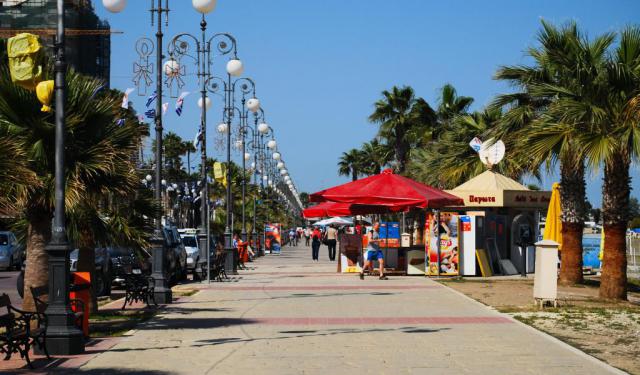
Seaside Promenade Walk
Throughout its multi-thousand-year history, Larnaca has "moved" several times, not only along the sea, but also inland and back, towards the shore. Today, the promenade of Larnaca is the very heart of the city, stretching for three kilometers.
For most tourists Larnaca is just the place where the Airport is located and the first thing they see upon arrival. During the day, herds of... view more
Tour Duration: 2 Hour(s)
Travel Distance: 3.0 Km or 1.9 Miles
For most tourists Larnaca is just the place where the Airport is located and the first thing they see upon arrival. During the day, herds of... view more
Tour Duration: 2 Hour(s)
Travel Distance: 3.0 Km or 1.9 Miles

Larnaca Introduction Walking Tour
Larnaca is the third-largest city in Cyprus. It was once a city-kingdom known as Kitoin. Though Kition was established in the 13th century BCE, the Phoenicians rebuilt the area around 1000 BCE. Some of the remains from this time, like cyclopean walls and temples, can still be seen today.
The modern name, Larnaca, is derived from the Greek word "larnax" due to the numerous burial sites... view more
Tour Duration: 1 Hour(s)
Travel Distance: 1.8 Km or 1.1 Miles
The modern name, Larnaca, is derived from the Greek word "larnax" due to the numerous burial sites... view more
Tour Duration: 1 Hour(s)
Travel Distance: 1.8 Km or 1.1 Miles