


St. Dunstans Church, Canterbury
Saint Dunstan’s Church is a quietly significant site with deep historical roots and royal connections. Located just outside the city’s Westgate, this modest parish church dates back to the 11th century and is named after Saint Dunstan, a 10th-century Archbishop of Canterbury and influential reformer. While the church itself has changed over the centuries, its importance lies not just in its age or architecture, but in the pivotal moments of English history that unfolded here.
One of the most notable events tied to Saint Dunstan’s is the burial of Saint Thomas More’s head. After his execution in 1535, More’s daughter, Margaret Roper, is said to have retrieved his head and brought it here for safekeeping. The family vault of her husband lies in the Roper Chapel, attached to the church, where visitors can reflect on this quiet act of resistance during turbulent Reformation times. This connection gives the church a strong resonance for those interested in Tudor history and Catholic martyrdom.
The church also played a role in the return of Thomas Becket’s body to Canterbury after his murder in 1170. Pilgrims would have passed this very site en route to his shrine in the cathedral, placing it on the map of the famed pilgrimage route described in Chaucer’s Canterbury Tales. Today, the church welcomes visitors with a calm and reverent atmosphere, where centuries of English religious and political history converge in a single, often overlooked building.
One of the most notable events tied to Saint Dunstan’s is the burial of Saint Thomas More’s head. After his execution in 1535, More’s daughter, Margaret Roper, is said to have retrieved his head and brought it here for safekeeping. The family vault of her husband lies in the Roper Chapel, attached to the church, where visitors can reflect on this quiet act of resistance during turbulent Reformation times. This connection gives the church a strong resonance for those interested in Tudor history and Catholic martyrdom.
The church also played a role in the return of Thomas Becket’s body to Canterbury after his murder in 1170. Pilgrims would have passed this very site en route to his shrine in the cathedral, placing it on the map of the famed pilgrimage route described in Chaucer’s Canterbury Tales. Today, the church welcomes visitors with a calm and reverent atmosphere, where centuries of English religious and political history converge in a single, often overlooked building.
Want to visit this sight? Check out these Self-Guided Walking Tours in Canterbury. Alternatively, you can download the mobile app "GPSmyCity: Walks in 1K+ Cities" from Apple App Store or Google Play Store. The app turns your mobile device to a personal tour guide and it works offline, so no data plan is needed when traveling abroad.
Download The GPSmyCity App


St. Dunstans Church on Map
Sight Name: St. Dunstans Church
Sight Location: Canterbury, England (See walking tours in Canterbury)
Sight Type: Religious
Sight Location: Canterbury, England (See walking tours in Canterbury)
Sight Type: Religious
Walking Tours in Canterbury, England

Create Your Own Walk in Canterbury
Creating your own self-guided walk in Canterbury is easy and fun. Choose the city attractions that you want to see and a walk route map will be created just for you. You can even set your hotel as the start point of the walk.

Canterbury Introduction Walking Tour
Canterbury is a UNESCO World Heritage City and one of the most visited cities in England. Canterbury has a long history and has been occupied since Paleolithic times. It was the capital of the Celtic Cantiaci, Romans settled the area for centuries, and the site was the capital of the Kingdom of Kent.
Saint Augustine arrived in Canterbury in 597 to convert the Anglo-Saxons to Christianity. The... view more
Tour Duration: 2 Hour(s)
Travel Distance: 2.7 Km or 1.7 Miles
Saint Augustine arrived in Canterbury in 597 to convert the Anglo-Saxons to Christianity. The... view more
Tour Duration: 2 Hour(s)
Travel Distance: 2.7 Km or 1.7 Miles
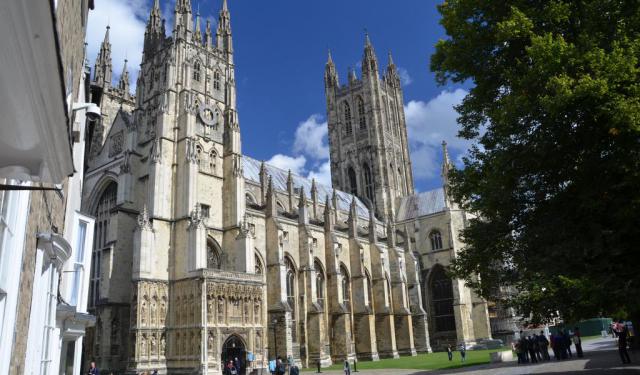
Canterbury Cathedral and Grounds
Canterbury Cathedral, one of the oldest churches that played a crucial role in English Christianity, stands within its own walled area, surrounded by Medieval buildings and ruins.
At the heart of this ensemble rises the cathedral itself, a magnificent example of medieval architecture and a UNESCO World Heritage Site. As you enter, you'll pass through the imposing Christ Church Gate, a... view more
Tour Duration: 1 Hour(s)
Travel Distance: 0.8 Km or 0.5 Miles
At the heart of this ensemble rises the cathedral itself, a magnificent example of medieval architecture and a UNESCO World Heritage Site. As you enter, you'll pass through the imposing Christ Church Gate, a... view more
Tour Duration: 1 Hour(s)
Travel Distance: 0.8 Km or 0.5 Miles