Custom Walk in Mexico City, Mexico by mclairehall_acf87 created on 2025-03-29
Guide Location: Mexico » Mexico City
Guide Type: Custom Walk
# of Sights: 8
Tour Duration: 2 Hour(s)
Travel Distance: 4.1 Km or 2.5 Miles
Share Key: KHED8
Guide Type: Custom Walk
# of Sights: 8
Tour Duration: 2 Hour(s)
Travel Distance: 4.1 Km or 2.5 Miles
Share Key: KHED8
How It Works
Please retrieve this walk in the GPSmyCity app. Once done, the app will guide you from one tour stop to the next as if you had a personal tour guide. If you created the walk on this website or come to the page via a link, please follow the instructions below to retrieve the walk in the app.
Retrieve This Walk in App
Step 1. Download the app "GPSmyCity: Walks in 1K+ Cities" on Apple App Store or Google Play Store.


Step 2. In the GPSmyCity app, download(or launch) the guide "Mexico City Map and Walking Tours".
Step 3. Tap the menu button located at upper right corner of the "Walks" screen and select "Retrieve custom walk". Enter the share key: KHED8

1) Museo Mural de Diego Rivera (Diego Rivera Mural Museum) (must see)
The Diego Rivera Mural Museum (Museo Mural Diego Rivera) stands as a distinctive venue created with a singular purpose-to showcase Diego Rivera's magnificent mural titled "Dream of a Sunday Afternoon in the Alameda Central" (Sueño de una Tarde Dominical en la Alameda Central).
Originally, this remarkable mural resided in the nearby Hotel del Prado. However, the devastating earthquake that struck the city in 1985 severely damaged the hotel, leading to the crucial decision to preserve and relocate the artwork to a safer location.
The delicate transportation of the mural necessitated cutting the wall on which it was painted, and a specially designed metal structure was employed to bear its immense 15-ton weight. This supporting structure remains in place to guard against any future earthquakes. Subsequently, the museum building was constructed around the mural, and in 1988, it was inaugurated in its present location near Alameda Park.
The mural's history traces back to 1946 when the architect Carlos Obregón Santacilia commissioned Diego Rivera to paint it for the Versailles dining room of Hotel del Prado. Rivera's chosen subject for the mural was Alameda Central Park, which lay just across the street.
Diego enthusiastically embraced the task and created a breathtaking fresco that narrated the history of Alameda Park, intertwined with that of Mexico as a whole, spanning from the era of Spanish colonization to the assassination of the democratically elected president, Francisco Madero, and the subsequent years of civil unrest.
This monumental painting measures an impressive 4.7 x 15.6 meters and features over 150 significant figures who have shaped the nation's history. Notable personalities such as Hernán Cortés, Benito Juárez, Maximiliano de Habsburgo, Francisco I Madero, Porfirio Díaz, and others find their place within the mural. Additionally, common folk like street vendors and revolutionaries, as well as Rivera's wives (including Frida Kahlo) and some of his daughters, are depicted.
Describing the mural, Rivera himself asserted that it encapsulates the memories of his life, encompassing his childhood and youth, spanning from 1895 to 1910. "All the characters are dreaming, some asleep on the benches and others walking and talking," he remarked.
Originally, this remarkable mural resided in the nearby Hotel del Prado. However, the devastating earthquake that struck the city in 1985 severely damaged the hotel, leading to the crucial decision to preserve and relocate the artwork to a safer location.
The delicate transportation of the mural necessitated cutting the wall on which it was painted, and a specially designed metal structure was employed to bear its immense 15-ton weight. This supporting structure remains in place to guard against any future earthquakes. Subsequently, the museum building was constructed around the mural, and in 1988, it was inaugurated in its present location near Alameda Park.
The mural's history traces back to 1946 when the architect Carlos Obregón Santacilia commissioned Diego Rivera to paint it for the Versailles dining room of Hotel del Prado. Rivera's chosen subject for the mural was Alameda Central Park, which lay just across the street.
Diego enthusiastically embraced the task and created a breathtaking fresco that narrated the history of Alameda Park, intertwined with that of Mexico as a whole, spanning from the era of Spanish colonization to the assassination of the democratically elected president, Francisco Madero, and the subsequent years of civil unrest.
This monumental painting measures an impressive 4.7 x 15.6 meters and features over 150 significant figures who have shaped the nation's history. Notable personalities such as Hernán Cortés, Benito Juárez, Maximiliano de Habsburgo, Francisco I Madero, Porfirio Díaz, and others find their place within the mural. Additionally, common folk like street vendors and revolutionaries, as well as Rivera's wives (including Frida Kahlo) and some of his daughters, are depicted.
Describing the mural, Rivera himself asserted that it encapsulates the memories of his life, encompassing his childhood and youth, spanning from 1895 to 1910. "All the characters are dreaming, some asleep on the benches and others walking and talking," he remarked.
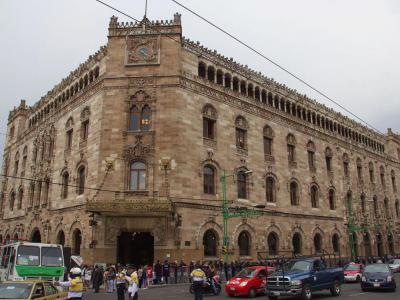
2) Palacio Postal (The Postal Palace)
Situated in the heart of Mexico City's Historic Center, the Postal Palace (Palacio de Correos), also known as the "Correo Mayor" (Main Post Office), stands as an architectural gem from the early 20th Century, a testament to the reign of President Porfirio Diaz.
The grand inauguration of the Main Post Office took place in 1907, marking its transition into a distinct government entity, separate from the Secretariat of Communications and Transportation, which it had been a part of until then. The visionary design of the building was a collaborative effort between Italian architect Adamo Boari and Mexican military engineer Gonzalo Garita y Frontera. With a sturdy foundation of steel frames and a vast grid of steel beams, the structure was ingeniously engineered to withstand earthquakes, setting it apart from many other buildings in Mexico City.
Within its walls, a fusion of European and Mexican architectural styles creates an awe-inspiring interior. Constructed using the exquisite light translucent stone known as Chiluca, the palace emanates a timeless beauty. In recognition of its significance and historical value, the building was rightfully declared an Artistic Monument in 1987 following extensive restoration efforts.
Today, the Palacio de Correos serves as a home to two captivating museums. On the ground floor, visitors can delve into the rich history of postal services in Mexico, accompanied by fascinating exhibits showcasing philately's wonders. Ascending to the 4th floor, one can explore the Naval Museum, which unravels Mexico's maritime legacy through maps, models, photographs, and maritime paintings crafted by renowned Mexican artists.
The grand inauguration of the Main Post Office took place in 1907, marking its transition into a distinct government entity, separate from the Secretariat of Communications and Transportation, which it had been a part of until then. The visionary design of the building was a collaborative effort between Italian architect Adamo Boari and Mexican military engineer Gonzalo Garita y Frontera. With a sturdy foundation of steel frames and a vast grid of steel beams, the structure was ingeniously engineered to withstand earthquakes, setting it apart from many other buildings in Mexico City.
Within its walls, a fusion of European and Mexican architectural styles creates an awe-inspiring interior. Constructed using the exquisite light translucent stone known as Chiluca, the palace emanates a timeless beauty. In recognition of its significance and historical value, the building was rightfully declared an Artistic Monument in 1987 following extensive restoration efforts.
Today, the Palacio de Correos serves as a home to two captivating museums. On the ground floor, visitors can delve into the rich history of postal services in Mexico, accompanied by fascinating exhibits showcasing philately's wonders. Ascending to the 4th floor, one can explore the Naval Museum, which unravels Mexico's maritime legacy through maps, models, photographs, and maritime paintings crafted by renowned Mexican artists.

3) Templo Mayor (The Great Temple) (must see)
A massive pyramid temple in the heart of the Tenochtitlán empire, the Great Temple (Templo Mayor) was once the crown jewel and the absolute center of the Mexica world before the Spanish conquest. First built around 1325, the structure stood almost 60 meters high and had dual staircases leading up to the two crowning temples, one dedicated to Huitzilopochtli, the god of sun and war, and the other to Tlaloc, the god of rain and agriculture.
After the Spanish conquered the city, the Temple was razed, but some of its traces remained. On February 21, 1978, electric company workers digging near the Metropolitan Cathedral uncovered an eight-ton monolith adorned with the carvings of the moon goddess Coyolxauhqui. The discovery prompted a major excavation during which four city blocks were demolished and the base of the Temple was revealed, along with multiple artifacts. In 2017, the space was further expanded to unearth partial remains of a round temple dedicated to the god Ehécatl, which is now open to the public.
The Aztec ruin of such magnitude is rather unique and includes traces of seven pyramids, as well as the Eagle Warrior Temple.
The adjoining eight-room museum showcases an extensive collection of pre-Colombian artifacts found on the site and is well worth two-four hours of your time, depending on your level of interest in Aztec religion, culture, and symbolism.
Tip:
The outside part can get very hot. Make sure to wear a hat and stay hydrated, or avoid the midday sun. If wishing to climb the Pyramid of the Sun, head there first because long lines can form early.
If you are not a Spanish speaker, check if there are audio guides available, because aside from some signage, most of the museum's text content is not translated into other languages.
Visitors can make reservations for a guided tour in English.
After the Spanish conquered the city, the Temple was razed, but some of its traces remained. On February 21, 1978, electric company workers digging near the Metropolitan Cathedral uncovered an eight-ton monolith adorned with the carvings of the moon goddess Coyolxauhqui. The discovery prompted a major excavation during which four city blocks were demolished and the base of the Temple was revealed, along with multiple artifacts. In 2017, the space was further expanded to unearth partial remains of a round temple dedicated to the god Ehécatl, which is now open to the public.
The Aztec ruin of such magnitude is rather unique and includes traces of seven pyramids, as well as the Eagle Warrior Temple.
The adjoining eight-room museum showcases an extensive collection of pre-Colombian artifacts found on the site and is well worth two-four hours of your time, depending on your level of interest in Aztec religion, culture, and symbolism.
Tip:
The outside part can get very hot. Make sure to wear a hat and stay hydrated, or avoid the midday sun. If wishing to climb the Pyramid of the Sun, head there first because long lines can form early.
If you are not a Spanish speaker, check if there are audio guides available, because aside from some signage, most of the museum's text content is not translated into other languages.
Visitors can make reservations for a guided tour in English.

4) Palacio Nacional (National Palace) (must see)
Stretching for over 200 meters (660 feet) across the entire east side of the Zócalo is the National Palace (Palacio Nacional), the official residence of the President of Mexico. Renowned for its grand red facade, made of volcanic rock called tezontle, this place has been the seat of a ruling class since the pre-Hispanic era. Much of the construction material for the current building was taken from the original palace of the 16th-century Aztec Emperor, Moctezuma II, which stood on this site and whose richness surprised the Spanish upon their arrival.
During the Conquest, the old palace wasn't completely destroyed. In the 1520s, Hernán Cortés built on its ruins a massive fortress which later became the official home for Spanish viceroys governing the colonies. The Spanish crown bought the property from the Cortés family in 1562 and thence called it the Palace of the Viceroy (Palacio del Virrey).
After the Mexican War of Independence in the 1820s, the building was renamed the "National Palace" and underwent structural changes. For a brief period, it was occupied by the country's two self-proclaimed emperors, Agustin de Iturbide and Maximilian I, and later became home to the first president of Mexico, Guadalupe Victoria.
The original church bell from the town of Dolores Hidalgo in Guanajuato state (once used to call for a rebellion against Spain in 1810) is now hung over the palace's main balcony. Each year, on Independence Day, September 15th, the president of Mexico rings the Dolores Bell in commemoration of that event.
The Palace has fourteen courtyards, of which only a few, like the Grand Courtyard, are open to the public. Here, the main stairwell and the walls (on the second floor) are adorned with murals by Diego Rivera, depicting the history of Mexico from 1521 to 1930, jointly titled "The Epic of the Mexican People".
Painted between 1929 and 1935, the work is presented in the form of a triptych, with the right-hand murals featuring pre-Hispanic Mexico centered around the life of the Aztec god Quetzalcóatl. The most extensive panel, in the middle, called the Conquest, showcases the sufferings endured by the indigenous people. The one on the left-hand side is dedicated to the early and mid-20th century, depicting a Marxist kind of utopia and featuring, among other persons, Diego's wife, Frida Kahlo.
Tip:
Since this is a government building, in order to get in you need to produce either a valid driver's license or passport. Bags, bottled water, hats, and sunglasses are not allowed.
During the Conquest, the old palace wasn't completely destroyed. In the 1520s, Hernán Cortés built on its ruins a massive fortress which later became the official home for Spanish viceroys governing the colonies. The Spanish crown bought the property from the Cortés family in 1562 and thence called it the Palace of the Viceroy (Palacio del Virrey).
After the Mexican War of Independence in the 1820s, the building was renamed the "National Palace" and underwent structural changes. For a brief period, it was occupied by the country's two self-proclaimed emperors, Agustin de Iturbide and Maximilian I, and later became home to the first president of Mexico, Guadalupe Victoria.
The original church bell from the town of Dolores Hidalgo in Guanajuato state (once used to call for a rebellion against Spain in 1810) is now hung over the palace's main balcony. Each year, on Independence Day, September 15th, the president of Mexico rings the Dolores Bell in commemoration of that event.
The Palace has fourteen courtyards, of which only a few, like the Grand Courtyard, are open to the public. Here, the main stairwell and the walls (on the second floor) are adorned with murals by Diego Rivera, depicting the history of Mexico from 1521 to 1930, jointly titled "The Epic of the Mexican People".
Painted between 1929 and 1935, the work is presented in the form of a triptych, with the right-hand murals featuring pre-Hispanic Mexico centered around the life of the Aztec god Quetzalcóatl. The most extensive panel, in the middle, called the Conquest, showcases the sufferings endured by the indigenous people. The one on the left-hand side is dedicated to the early and mid-20th century, depicting a Marxist kind of utopia and featuring, among other persons, Diego's wife, Frida Kahlo.
Tip:
Since this is a government building, in order to get in you need to produce either a valid driver's license or passport. Bags, bottled water, hats, and sunglasses are not allowed.

5) Zocalo (Constitution Square) (must see)
Formally known as Constitution Square (Plaza de la Constitución), this is one of Mexico City's most historically and culturally intriguing destinations. The central square of the Mexican capital is also one of the largest public squares in the world, measuring 57,600 square meters and capable of holding up to 100,000 people at once!
Previously called Arms Square (Plaza de Armas) or Main Square (Plaza Principal), it is nowadays more commonly referred to as El Zócalo, which means "the plinth". This nickname was adopted in the 19th century and refers to the monument intended to be erected in the plaza, but never materialized (apart from its plinth). While the plinth is long gone now, the name stuck.
The grand square was established circa the 14th century AD and once served as a ceremonial hub of the Aztec city, Tenochtitlán; it was also a major marketplace. The historic spot that we see today started to take shape in the post-colonization period, thanks to the architectural efforts of Alonso García Bravo, a Spanish mercenary who took part in the Conquest of Mexico and was also a master builder and urban planner.
Throughout much of the 17th century, the plaza was overrun with market stalls. In the 1860s, Emperor Maximilian I expelled all merchants from the area; however, from the latter half of the 19th century to the early 20th, it was once again filled with market activity.
In 1914, the plaza was cleared of all the ash trees planted during the previous century and turned into a Parisian-style park, with tree-lined walkways, benches, and grassy areas. Also, each corner of the plaza was fitted with palm trees.
What was previously dominated by the looming silhouettes of Tenochtitlan's temples and pyramids, such as the Great Temple, today is ringed by similarly emblematic buildings like the Metropolitan Cathedral, the National Palace, the National Museum of Arts, and the House of Tiles.
A giant Mexican flag (ceremoniously lowered every evening, at six o'clock) enjoys the pride of place in the center of the plaza. In the heat of the day, you can see crowds of people taking shelter in the flagpole's shade. Concerts, street shows, public gatherings, as well as a massive ice rink (in December) are among the regular things to watch for in the Zócalo.
Tip:
Amid the lack of shade, the square often feels like a hell's kitchen, so consider opting for a cooler part of the day for maximum enjoyment. Alternatively, you can go up to the Hotel Gran Ciudad de México's terrace for a great photo op, or have lunch at Balcón del Zócalo, a rooftop restaurant in the Zócalo Central Hotel, which offers gorgeous views of the plaza.
Previously called Arms Square (Plaza de Armas) or Main Square (Plaza Principal), it is nowadays more commonly referred to as El Zócalo, which means "the plinth". This nickname was adopted in the 19th century and refers to the monument intended to be erected in the plaza, but never materialized (apart from its plinth). While the plinth is long gone now, the name stuck.
The grand square was established circa the 14th century AD and once served as a ceremonial hub of the Aztec city, Tenochtitlán; it was also a major marketplace. The historic spot that we see today started to take shape in the post-colonization period, thanks to the architectural efforts of Alonso García Bravo, a Spanish mercenary who took part in the Conquest of Mexico and was also a master builder and urban planner.
Throughout much of the 17th century, the plaza was overrun with market stalls. In the 1860s, Emperor Maximilian I expelled all merchants from the area; however, from the latter half of the 19th century to the early 20th, it was once again filled with market activity.
In 1914, the plaza was cleared of all the ash trees planted during the previous century and turned into a Parisian-style park, with tree-lined walkways, benches, and grassy areas. Also, each corner of the plaza was fitted with palm trees.
What was previously dominated by the looming silhouettes of Tenochtitlan's temples and pyramids, such as the Great Temple, today is ringed by similarly emblematic buildings like the Metropolitan Cathedral, the National Palace, the National Museum of Arts, and the House of Tiles.
A giant Mexican flag (ceremoniously lowered every evening, at six o'clock) enjoys the pride of place in the center of the plaza. In the heat of the day, you can see crowds of people taking shelter in the flagpole's shade. Concerts, street shows, public gatherings, as well as a massive ice rink (in December) are among the regular things to watch for in the Zócalo.
Tip:
Amid the lack of shade, the square often feels like a hell's kitchen, so consider opting for a cooler part of the day for maximum enjoyment. Alternatively, you can go up to the Hotel Gran Ciudad de México's terrace for a great photo op, or have lunch at Balcón del Zócalo, a rooftop restaurant in the Zócalo Central Hotel, which offers gorgeous views of the plaza.
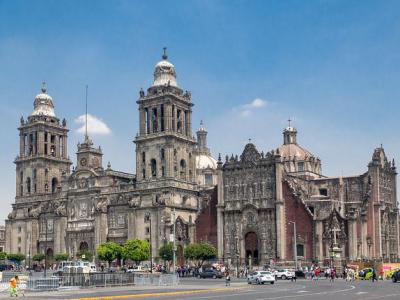
6) Catedral Metropolitana (Metropolitan Cathedral) (must see)
Dominating the Zócalo to the north is the Metropolitan Cathedral, the oldest and largest European church in the Western Hemisphere. The temple sits on the site of the former Aztec sacred precinct, the palace of Moctezuma, destroyed during the Spanish conquest.
The cathedral's first stone was laid in 1553, set to replace the modest church built in this place in 1524. The whole building took nearly 250 years to complete, from 1573 to 1813, over which period numerous architects, sculptors, and painters worked on it, bringing in a dazzling array of styles (Gothic, Baroque, Neoclassical, Renaissance, and even Churrigueresque) and diverse decorations. An exceptional collection of paintings, statues, and glittering altarpieces found inside the cathedral are complemented by the largest in the Americas 18th-century organs (nowadays frequently used in musical concerts).
A mortar-and-stone symbol of Catholicism in Mexico's life, this cathedral was often at the epicenter of historically important events, such as the coronation of Agustín de Iturbide and Ana María Huarte as the first emperors of Mexico in 1822, and many others.
Throughout its long life, the cathedral suffered multiple damages. During the earthquake on September 19, 2017, a cross known as La Esperanza, which used to crown one of the two belfries, toppled and fell to the ground. The spot where it landed is now an attraction in its own right.
Tip:
Since this is a functioning cathedral, make sure to avoid mass hours.
Walk down the sloping floor from the altar towards the back of the church, and look for the large pendulum suspended from the ceiling which tracks how much the building has sunk (due to the soft clay subsoil on which it stands) by marking a record on the floor. Also, check out the doorways and columns to see how the church is leaning.
Don't miss the Black Jesus (aka the "Lord of Poison") statue in the chapel at the back (you may want to read in advance to see why it's famous).
The cathedral's first stone was laid in 1553, set to replace the modest church built in this place in 1524. The whole building took nearly 250 years to complete, from 1573 to 1813, over which period numerous architects, sculptors, and painters worked on it, bringing in a dazzling array of styles (Gothic, Baroque, Neoclassical, Renaissance, and even Churrigueresque) and diverse decorations. An exceptional collection of paintings, statues, and glittering altarpieces found inside the cathedral are complemented by the largest in the Americas 18th-century organs (nowadays frequently used in musical concerts).
A mortar-and-stone symbol of Catholicism in Mexico's life, this cathedral was often at the epicenter of historically important events, such as the coronation of Agustín de Iturbide and Ana María Huarte as the first emperors of Mexico in 1822, and many others.
Throughout its long life, the cathedral suffered multiple damages. During the earthquake on September 19, 2017, a cross known as La Esperanza, which used to crown one of the two belfries, toppled and fell to the ground. The spot where it landed is now an attraction in its own right.
Tip:
Since this is a functioning cathedral, make sure to avoid mass hours.
Walk down the sloping floor from the altar towards the back of the church, and look for the large pendulum suspended from the ceiling which tracks how much the building has sunk (due to the soft clay subsoil on which it stands) by marking a record on the floor. Also, check out the doorways and columns to see how the church is leaning.
Don't miss the Black Jesus (aka the "Lord of Poison") statue in the chapel at the back (you may want to read in advance to see why it's famous).
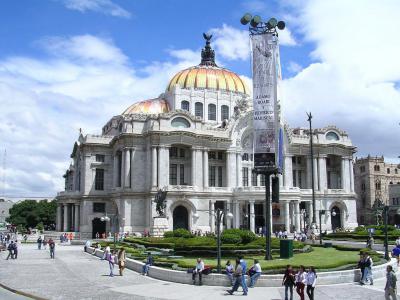
7) Palacio de Bellas Artes (Palace of Fine Arts) (must see)
The majestic Palace of Fine Arts (Palacio de Bellas Artes) is a major cultural spot in Mexico City, a regular host of notable events (shows, concerts, and art exhibitions).
Construction on the palace began in 1904, directed by Italian architect Adamo Boari, but was halted in 1913 because of the complications arisen from the soft soil and the erupted Mexican Revolution. Twenty years later, the local architect Federico Mariscal took over the project and had it finished by 1934.
The palace shows a mixture of architectural styles; its exterior is primarily Art Nouveau and Neoclassical, while the interior is dominated by Art Deco.
The main facade, overlooking Avenida Juárez, is clad in white Carrara marble from Italy. Inside the portal, there are sculptural images of Harmony, Pain, Rage, Happiness, Peace, and Love. Another portion of the facade contains cherubs and sculptures representing Music and Inspiration. On the plaza in front of the building, there are four Pegasus sculptures (originally placed in the Zocalo, they were brought here eventually).
The interior is divided into three sections: the main hall; the theater; and the offices of the National Institute of Fine Arts. The second floor has smaller exhibition halls, and the third floor is occupied by the Museum of Architecture.
The building is best known for its murals by Diego Rivera, David Alfaro Siqueiros, and other prominent Mexican artists. On the north side of the third floor, you can see Siqueiros's three-part "New Democracy" (La Nueva Democracia) fresco, while at the west end of the same floor is Diego Rivera's controversial "Man, Controller of the Universe" (El Hombre Controlador Del Universo), more commonly known as "Man at the Crossroads". This mural was originally commissioned for New York's Rockefeller Center in 1933. The Rockefellers canceled the project halfway through unhappy that Rivera had included in the piece the image of Lenin and a Soviet May Day parade. The incomplete work was painted over, following which Rivera recreated it here.
The on-site theater is also famous as the place of the debut of Maria Callas in the opera Norma in 1950, among other things. The crystal roof over the stage, depicting Muses with Apollo and other mythological creatures, is yet another attraction – was brought from Hungary.
Still, the most impacting aspect of the theater is the stage "curtain" which is a stained glass foldable panel made up of nearly one million pieces of iridescent colored glass, created by Tiffany's in New York. This stage curtain is the only one of its type; it stretches up some 200 feet and weighs 24 tons. The design was inspired by the work of the Mexican artist Dr. Atl (Gerardo Murillo Cornado).
Tip:
If you want to see the Tiffany "glass curtain", you can join a free tour every Friday at 1:30 pm.
If you want a great picture, go up the Latin-American Tower across the street and find your way to the observation deck.
If you want free admission, come on Sunday, but be prepared to queue at the box office inside.
Construction on the palace began in 1904, directed by Italian architect Adamo Boari, but was halted in 1913 because of the complications arisen from the soft soil and the erupted Mexican Revolution. Twenty years later, the local architect Federico Mariscal took over the project and had it finished by 1934.
The palace shows a mixture of architectural styles; its exterior is primarily Art Nouveau and Neoclassical, while the interior is dominated by Art Deco.
The main facade, overlooking Avenida Juárez, is clad in white Carrara marble from Italy. Inside the portal, there are sculptural images of Harmony, Pain, Rage, Happiness, Peace, and Love. Another portion of the facade contains cherubs and sculptures representing Music and Inspiration. On the plaza in front of the building, there are four Pegasus sculptures (originally placed in the Zocalo, they were brought here eventually).
The interior is divided into three sections: the main hall; the theater; and the offices of the National Institute of Fine Arts. The second floor has smaller exhibition halls, and the third floor is occupied by the Museum of Architecture.
The building is best known for its murals by Diego Rivera, David Alfaro Siqueiros, and other prominent Mexican artists. On the north side of the third floor, you can see Siqueiros's three-part "New Democracy" (La Nueva Democracia) fresco, while at the west end of the same floor is Diego Rivera's controversial "Man, Controller of the Universe" (El Hombre Controlador Del Universo), more commonly known as "Man at the Crossroads". This mural was originally commissioned for New York's Rockefeller Center in 1933. The Rockefellers canceled the project halfway through unhappy that Rivera had included in the piece the image of Lenin and a Soviet May Day parade. The incomplete work was painted over, following which Rivera recreated it here.
The on-site theater is also famous as the place of the debut of Maria Callas in the opera Norma in 1950, among other things. The crystal roof over the stage, depicting Muses with Apollo and other mythological creatures, is yet another attraction – was brought from Hungary.
Still, the most impacting aspect of the theater is the stage "curtain" which is a stained glass foldable panel made up of nearly one million pieces of iridescent colored glass, created by Tiffany's in New York. This stage curtain is the only one of its type; it stretches up some 200 feet and weighs 24 tons. The design was inspired by the work of the Mexican artist Dr. Atl (Gerardo Murillo Cornado).
Tip:
If you want to see the Tiffany "glass curtain", you can join a free tour every Friday at 1:30 pm.
If you want a great picture, go up the Latin-American Tower across the street and find your way to the observation deck.
If you want free admission, come on Sunday, but be prepared to queue at the box office inside.
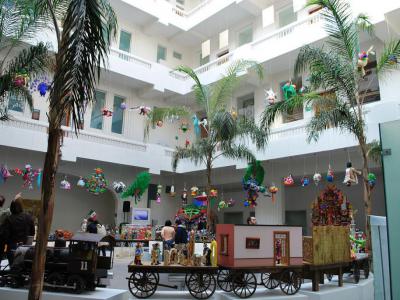
8) Museo de Arte Popular (Popular Art Museum)
The Popular Art Museum (Museo de Arte Popular) situated in the heart of Mexico City's Historic Center, finds its home in a former firehouse that boasts an elegant Art Deco design. Originally crafted by architect Vincente Mediola, this building once served as a bustling hub for fire service, with a central hall accommodating fire engines and three floors housing offices and residences. The exterior showcases an impressive stone facade adorned with ancient Aztec reliefs, each artfully embellished with motifs. A significant addition is the tower, equipped with a signal light, standing at the nearby intersection, ready to respond to emergencies.
Donated by the government of Mexico City, this historic building was entrusted to Teodoro Gonzales de Leon for restoration, transforming it into a sanctuary for Mexican folk arts and handicrafts. Within its walls now thrives a repository of cultural traditions, dedicated not only to promoting these cherished art forms but also to their preservation. The museum actively engages in nurturing the craft's continuity through workshops where young minds learn to create traditional crafts, ensuring that the heritage endures for generations to come.
Since its inauguration in 2006, the Museo de Arte Popular has amassed an extensive collection of precious treasures, including textiles, pottery, glass handicrafts, piñatas, and enchanting figures known as alebrijes, which depict fantastical creatures. Among its annual highlights is the vibrant "Noche de Alebrijes" parade, proudly sponsored by the museum, where the grand alebrijes take to the streets, while their creators eagerly compete for esteemed prizes. This celebration serves as a testament to the boundless creativity and spirit that embodies the heart of Mexican folk art.
Why You Should Visit:
When you enter this museum, you feel immediately energized by the colors and gorgeous displays of fantastic art! Small and very do-able to walk through and see everything in under 2 hours. The gift shop has tons of crafts from all over the country and many potential fun buys!
Tip:
Make sure to start your visit on the top floor and work your way down.
Donated by the government of Mexico City, this historic building was entrusted to Teodoro Gonzales de Leon for restoration, transforming it into a sanctuary for Mexican folk arts and handicrafts. Within its walls now thrives a repository of cultural traditions, dedicated not only to promoting these cherished art forms but also to their preservation. The museum actively engages in nurturing the craft's continuity through workshops where young minds learn to create traditional crafts, ensuring that the heritage endures for generations to come.
Since its inauguration in 2006, the Museo de Arte Popular has amassed an extensive collection of precious treasures, including textiles, pottery, glass handicrafts, piñatas, and enchanting figures known as alebrijes, which depict fantastical creatures. Among its annual highlights is the vibrant "Noche de Alebrijes" parade, proudly sponsored by the museum, where the grand alebrijes take to the streets, while their creators eagerly compete for esteemed prizes. This celebration serves as a testament to the boundless creativity and spirit that embodies the heart of Mexican folk art.
Why You Should Visit:
When you enter this museum, you feel immediately energized by the colors and gorgeous displays of fantastic art! Small and very do-able to walk through and see everything in under 2 hours. The gift shop has tons of crafts from all over the country and many potential fun buys!
Tip:
Make sure to start your visit on the top floor and work your way down.
