Custom Walk in Milan, Italy by advikamore_ef559 created on 2025-04-21
Guide Location: Italy » Milan
Guide Type: Custom Walk
# of Sights: 10
Tour Duration: 3 Hour(s)
Travel Distance: 7.2 Km or 4.5 Miles
Share Key: 5S8HJ
Guide Type: Custom Walk
# of Sights: 10
Tour Duration: 3 Hour(s)
Travel Distance: 7.2 Km or 4.5 Miles
Share Key: 5S8HJ
How It Works
Please retrieve this walk in the GPSmyCity app. Once done, the app will guide you from one tour stop to the next as if you had a personal tour guide. If you created the walk on this website or come to the page via a link, please follow the instructions below to retrieve the walk in the app.
Retrieve This Walk in App
Step 1. Download the app "GPSmyCity: Walks in 1K+ Cities" on Apple App Store or Google Play Store.


Step 2. In the GPSmyCity app, download(or launch) the guide "Milan Map and Walking Tours".
Step 3. Tap the menu button located at upper right corner of the "Walks" screen and select "Retrieve custom walk". Enter the share key: 5S8HJ

1) Duomo di Milano (Milan Cathedral) (must see)
The Milan Cathedral, otherwise known as the Duomo, is the seat of the Archbishop of Milan and the largest church in Italy (the third largest in Europe and the fourth largest in the world), covering an area of 12,000 sqm and weighing a staggering 325,000 tons!
The cathedral is dedicated to Saint Mary Nascent and has been the epicenter of the city's life since 1386. Its foundation was laid by Gian Galeazzo Visconti, who died in 1402 when only half of the structure had been finished, upon which the construction came to a standstill for almost 80 years because of the lack of funds and ideas. It resumed only in 1500, and by 1510 the octagonal dome was completed – embellished with four series of 15 statues representing different characters from the Bible.
In 1805, Napoleon Bonaparte forced completion of the façade, which overall took another seven years of work. In honor of his efforts, a statue of Napoleon was erected at the top of one of the spires. Later, the Duomo also hosted his crowning ceremony. However, it wasn't until the 20th century, with the completion of the last gate, that the centuries-long construction of the cathedral was finally over, marked by inauguration on January 6, 1965.
A climb to the roof, much as a descend to the Paleo Christian baptistery beneath the west side of the Duomo are the highlights of a visit here. The rooftop offers a closer look at the intricate details of the spires and the gargoyles adorning it, plus a breathtaking view over of the city, some 70 meters above ground, replete with myriads of statues, pinnacles, tracery and flying buttresses. In order to get there, visitors have to traverse 201 stairs up through a winding narrow passageway, which is a bit tiring. Still, those who wish, can spare the effort and use an elevator.
Why You Should Visit:
Milan's one truly must-visit sight – a vast riot of ornate religious sculpture on the exterior, and the interior sublimely huge.
Tip:
Buy an online skip-the-line ticket that covers entry and access to the elevator.
The surrounding piazza comes at its finest at night when the cathedral's façade is lit by white lights.
The cathedral is dedicated to Saint Mary Nascent and has been the epicenter of the city's life since 1386. Its foundation was laid by Gian Galeazzo Visconti, who died in 1402 when only half of the structure had been finished, upon which the construction came to a standstill for almost 80 years because of the lack of funds and ideas. It resumed only in 1500, and by 1510 the octagonal dome was completed – embellished with four series of 15 statues representing different characters from the Bible.
In 1805, Napoleon Bonaparte forced completion of the façade, which overall took another seven years of work. In honor of his efforts, a statue of Napoleon was erected at the top of one of the spires. Later, the Duomo also hosted his crowning ceremony. However, it wasn't until the 20th century, with the completion of the last gate, that the centuries-long construction of the cathedral was finally over, marked by inauguration on January 6, 1965.
A climb to the roof, much as a descend to the Paleo Christian baptistery beneath the west side of the Duomo are the highlights of a visit here. The rooftop offers a closer look at the intricate details of the spires and the gargoyles adorning it, plus a breathtaking view over of the city, some 70 meters above ground, replete with myriads of statues, pinnacles, tracery and flying buttresses. In order to get there, visitors have to traverse 201 stairs up through a winding narrow passageway, which is a bit tiring. Still, those who wish, can spare the effort and use an elevator.
Why You Should Visit:
Milan's one truly must-visit sight – a vast riot of ornate religious sculpture on the exterior, and the interior sublimely huge.
Tip:
Buy an online skip-the-line ticket that covers entry and access to the elevator.
The surrounding piazza comes at its finest at night when the cathedral's façade is lit by white lights.

2) Piazza del Duomo (Cathedral Square) (must see)
The gigantic central piazza, milling with people and pigeons, is awe-inspiring, with the Museo del Novecento being a particularly impressive sight. No cafés spill onto it, but the historic Camparino is tucked under the porticoes, created by the founder of the Campari dynasty in 1867. It was here, at the entrance to Galleria Vittorio Emanuele, that Verdi used to enjoy a drink after concerts and where, in 1877, Milanese nobility flocked to see the first experiment in electric lighting. It was also here, in this Art Nouveau interior, that stressed Milanese still relax over a coffee or Campari, served with over-sized olives.
The Palazzo Reale (Royal Palace) on the south side of the Duomo stands on the site of the original Broletto or town hall, destroyed by Frederick Barbarossa in 1162. It was rebuilt in 1171, then later transformed into the Ducal Palace for the Visconti and Sforza dynasties. On the occasion of Galeazzo Visconti’s marriage to Beatrice d’Este in Modena, their entry into Milan was marked by eight days of festivities at the palace. In 1336 the Church of San Gottardo in Corte was built as the Visconti’s private chapel. You can still see the charming colonnaded campanile rising to the rear of the palace, but the church itself was destroyed when the building was incorporated into the neoclassical palace. In 1412 the church steps were the scene of the murder of Giovanni Maria Visconti; as a consequence, the family decided to reside in the safer environs of the fortified castle. Under the Sforza a theatre was established at the palace, and in 1595 Mozart, who was only 14, performed here.
Another unmissable landmark in the piazza is, of course, Ercole Rosa's 1896 equestrian statue of Vittorio Emanuele II, first king of Italy, who triumphantly entered Milan in 1859.
The Palazzo Reale (Royal Palace) on the south side of the Duomo stands on the site of the original Broletto or town hall, destroyed by Frederick Barbarossa in 1162. It was rebuilt in 1171, then later transformed into the Ducal Palace for the Visconti and Sforza dynasties. On the occasion of Galeazzo Visconti’s marriage to Beatrice d’Este in Modena, their entry into Milan was marked by eight days of festivities at the palace. In 1336 the Church of San Gottardo in Corte was built as the Visconti’s private chapel. You can still see the charming colonnaded campanile rising to the rear of the palace, but the church itself was destroyed when the building was incorporated into the neoclassical palace. In 1412 the church steps were the scene of the murder of Giovanni Maria Visconti; as a consequence, the family decided to reside in the safer environs of the fortified castle. Under the Sforza a theatre was established at the palace, and in 1595 Mozart, who was only 14, performed here.
Another unmissable landmark in the piazza is, of course, Ercole Rosa's 1896 equestrian statue of Vittorio Emanuele II, first king of Italy, who triumphantly entered Milan in 1859.

3) Via Torino (Torino Street)
Via Torino is a shopping destination suitable for everyone as it stretches from Piazza Duomo and leads directly to Columns of San Lorenzo square, where one can end their day of shopping with an aperitivo among the lively Milanese nightlife.
In the past, important artisanal workshops and laboratories were established here, and their influence is still felt today in adjacent streets such as Via Orefici, Via Spadari, and Via Speronari. It wasn't until 1859 that the street took on its current name, and it has undergone significant urban transformations over the years.
If you're a lover of shoes, particularly of sneakers, then this is the place to be. Via Torino is the hub for shoes, clothing, skateboards, technical accessories, backpacks, and sportswear for football and basketball. Moreover, its adjacent streets are adorned with sports shops, particularly those selling colorful sneakers in true American style.
Apart from shopping, make sure to visit some small gems such as the Renaissance Basilica of Santa Maria presso San Satiro while wandering from one shop to another.
In the past, important artisanal workshops and laboratories were established here, and their influence is still felt today in adjacent streets such as Via Orefici, Via Spadari, and Via Speronari. It wasn't until 1859 that the street took on its current name, and it has undergone significant urban transformations over the years.
If you're a lover of shoes, particularly of sneakers, then this is the place to be. Via Torino is the hub for shoes, clothing, skateboards, technical accessories, backpacks, and sportswear for football and basketball. Moreover, its adjacent streets are adorned with sports shops, particularly those selling colorful sneakers in true American style.
Apart from shopping, make sure to visit some small gems such as the Renaissance Basilica of Santa Maria presso San Satiro while wandering from one shop to another.
4) La Rinascente
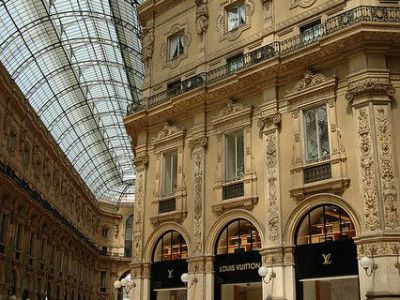
Founded in 1865, La Rinascente is a classical fashion department store in Milan that has been recognized as the most modern shopping place. In this enormous, eight-storey(!) super mall you can find practically everything you can possibly think of, from lingerie to the colorful ceramics to latest cosmetics to accessories and footwear. The top floor is home to a delicatessen, indoor-outdoor café and innumerable gastro bars offering Italian cuisine, sushi, wines, juices, chocolate, coffee and cheeses (there's a branch of Obikà mozzarella bar), etc. In addition to gastronomic pleasures, visitors can also enjoy a panoramic view of the Duomo cathedral.
Following the renovation of 2008, La Rinascente had its mall-like appearance replaced by a boutique feel. All in all, this is a great place to walk around, do shopping and enjoy a drink or a meal in the comfy environment of the many on-site restaurants.
Tip:
They have clean bathrooms on the top floor, and there is no fee. When you're there, just walk over to the big windows and get a bird's eye view of the Duomo, while enjoying the air conditioning.
If you need to get Tax Refund, collect all your receipts from La Rinascente and process them on the same day on the same top floor. The receipts are only valid for tax refund if done the same day, so it is better to do all your shopping at La Rinascente in one day, then proceed to the Tax Refund and complete a single form including all receipts.
Following the renovation of 2008, La Rinascente had its mall-like appearance replaced by a boutique feel. All in all, this is a great place to walk around, do shopping and enjoy a drink or a meal in the comfy environment of the many on-site restaurants.
Tip:
They have clean bathrooms on the top floor, and there is no fee. When you're there, just walk over to the big windows and get a bird's eye view of the Duomo, while enjoying the air conditioning.
If you need to get Tax Refund, collect all your receipts from La Rinascente and process them on the same day on the same top floor. The receipts are only valid for tax refund if done the same day, so it is better to do all your shopping at La Rinascente in one day, then proceed to the Tax Refund and complete a single form including all receipts.
5) Galleria Vittorio Emanuele II (Vittorio Emanuele II Gallery) (must see)
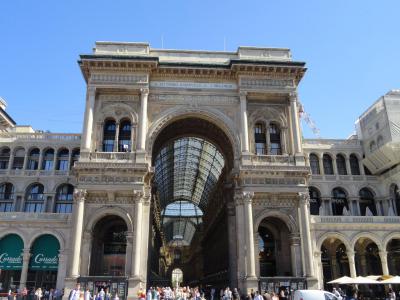
Galleria Vittorio Emanuele II is a fashionable five-storey mall covered in curved glass, topped with iron roof and lavishly decorated with patriotic mosaics and statues – legacy of the chaotic era of Italian unification, manifesting the country's newly-acquired self-confidence.
It was built between 1865 and 1877 by architect Giuseppe Mengoni – who is also credited with the monumental design of the entire area between the Milan Cathedral and La Scala – and is named after Vittorio Emanuele II, the first king of unified Italy. Officially inaugurated on September 15, 1867, the Galleria's completion took another ten years of continuous work. Tragically, just a day before it was over, in December 1877, Giuseppe Mengoni died in accident, falling down from the top of the triumphal arch.
Designed in the form of a Latin cross, the gallery comprises two glass-vaulted covered passages, with the longer one being 196 meters and the shorter – 105.5 meters long, crossing in an octagonal central piazza below an impressive 47-meter high, 36-meter wide glass dome. Incorporating iron and arching glass, the Galleria's architectural design proved groundbreaking for the creation of enclosed shopping malls in the 19th century. Moreover, its use of an iron structure inspired the Eiffel Tower in Paris.
An interesting feature of the gallery is the floor adorned with marble mosaics depicting emblems of the main Italian cities. Locals believe that stepping on the bull's image in the middle of the floor with a heel of the right foot and spinning around can bring good luck. Adherence to this tradition has already left a hole there.
Why You Should Visit:
Almost like stepping into the picture of 19th-century Milan with its lights, colors, windows and landscaping that will never fade in your memory.
There are a few restaurants (incidentally not very expensive, considering it's 'the mall') where you can sit back, eat to your heart's content, and watch the crowds go by.
There's also a very nice Leonardo Museum at the end of the mall, bang opposite the statue of Leonardo da Vinci.
Tip:
Try to visit late at night or early in the morning when there aren't that many people in.
Don't forget to find the "bull" on the floor and have fun!
It was built between 1865 and 1877 by architect Giuseppe Mengoni – who is also credited with the monumental design of the entire area between the Milan Cathedral and La Scala – and is named after Vittorio Emanuele II, the first king of unified Italy. Officially inaugurated on September 15, 1867, the Galleria's completion took another ten years of continuous work. Tragically, just a day before it was over, in December 1877, Giuseppe Mengoni died in accident, falling down from the top of the triumphal arch.
Designed in the form of a Latin cross, the gallery comprises two glass-vaulted covered passages, with the longer one being 196 meters and the shorter – 105.5 meters long, crossing in an octagonal central piazza below an impressive 47-meter high, 36-meter wide glass dome. Incorporating iron and arching glass, the Galleria's architectural design proved groundbreaking for the creation of enclosed shopping malls in the 19th century. Moreover, its use of an iron structure inspired the Eiffel Tower in Paris.
An interesting feature of the gallery is the floor adorned with marble mosaics depicting emblems of the main Italian cities. Locals believe that stepping on the bull's image in the middle of the floor with a heel of the right foot and spinning around can bring good luck. Adherence to this tradition has already left a hole there.
Why You Should Visit:
Almost like stepping into the picture of 19th-century Milan with its lights, colors, windows and landscaping that will never fade in your memory.
There are a few restaurants (incidentally not very expensive, considering it's 'the mall') where you can sit back, eat to your heart's content, and watch the crowds go by.
There's also a very nice Leonardo Museum at the end of the mall, bang opposite the statue of Leonardo da Vinci.
Tip:
Try to visit late at night or early in the morning when there aren't that many people in.
Don't forget to find the "bull" on the floor and have fun!

6) La Scala (Opera House and Museum) (must see)
The La Scala Theatre Chorus, Ballet, and Orchestra make it one of the premier musical theaters worldwide. Inaugurated in 1778, the famous opera house in Milan has welcomed some of the finest singers from Italy and around the globe.
After the Teatro Regio Ducale burned down in 1776, a new theater was erected on the site of the former church of Santa Maria alla Scala, from which it derived its name. The cost of building the theater was covered by sales of theatrical boxes, which were exquisitely decorated and made a lasting impression on guests, including the prominent French author Stendhal. Soon, La Scala became a preferred gathering spot for high society. In accordance with the tradition of the time, the main floor had no chairs, and audiences had to stand to watch the shows. Additionally, the orchestra pit had yet to be constructed.
Badly damaged during World War II, La Scala underwent a complete restoration before reopening in 1946. To commemorate the occasion, Arturo Toscanini arranged an unforgettable concert featuring a sensational solo by Renata Tebaldi. From 2002 to 2004, the theater underwent a major renovation. Despite its plain facade, the La Scala interior is stunningly elegant and intimate, surpassing that of opera houses in New York and London.
Why You Should Visit:
The La Scala Orchestra, comprising 135 musicians, is one of the world's most outstanding orchestras for opera productions, known for its ability to produce a uniform and distinguished sound. The theater is also internationally acclaimed for its symphonic activities. The La Scala museum houses one of the richest and most coveted collections of music-themed artifacts worldwide. A tour of the theater provides a rare opportunity to sit in its most prominent box and take photos.
Tip:
Do not buy second-row balcony tickets unless you are quite tall.
After 6pm, same-day tickets are sold at a substantial discount.
After the Teatro Regio Ducale burned down in 1776, a new theater was erected on the site of the former church of Santa Maria alla Scala, from which it derived its name. The cost of building the theater was covered by sales of theatrical boxes, which were exquisitely decorated and made a lasting impression on guests, including the prominent French author Stendhal. Soon, La Scala became a preferred gathering spot for high society. In accordance with the tradition of the time, the main floor had no chairs, and audiences had to stand to watch the shows. Additionally, the orchestra pit had yet to be constructed.
Badly damaged during World War II, La Scala underwent a complete restoration before reopening in 1946. To commemorate the occasion, Arturo Toscanini arranged an unforgettable concert featuring a sensational solo by Renata Tebaldi. From 2002 to 2004, the theater underwent a major renovation. Despite its plain facade, the La Scala interior is stunningly elegant and intimate, surpassing that of opera houses in New York and London.
Why You Should Visit:
The La Scala Orchestra, comprising 135 musicians, is one of the world's most outstanding orchestras for opera productions, known for its ability to produce a uniform and distinguished sound. The theater is also internationally acclaimed for its symphonic activities. The La Scala museum houses one of the richest and most coveted collections of music-themed artifacts worldwide. A tour of the theater provides a rare opportunity to sit in its most prominent box and take photos.
Tip:
Do not buy second-row balcony tickets unless you are quite tall.
After 6pm, same-day tickets are sold at a substantial discount.

7) Quartiere Brera (Brera District)
Milan's Brera district is one of the city's most charming and historic neighborhoods, sometimes referred to as "the Milanese Montmartre". Known for its narrow, winding streets lined with antique shops, art galleries, and fashionable boutiques, Brera offers visitors a glimpse into Milan's rich cultural heritage.
One of the district's main attractions is the Pinacoteca di Brera, a world-class art museum housed in a beautiful 18th-century palace. The museum boasts an impressive collection of Italian Renaissance art, including works by some of the most famous artists of the era, such as Raphael, Caravaggio, and Titian.
Another must-see attraction is the Orto Botanico di Brera, a botanical garden located in the heart of the neighborhood. Founded in the late 18th century, it is home to over 4,000 species of plants, including many rare and exotic specimens.
The district is also home to the historic Teatro alla Scala, one of the world's most famous opera houses. Visitors can take a tour of the theater, which has hosted some of the greatest names in opera and ballet.
For those interested in shopping, the streets of Brera are filled with high-end boutiques, designer shops, and artisanal crafts stores. There are also plenty of cafes and restaurants, making it a popular destination for foodies and coffee lovers.
Overall, a vibrant and lively district with plenty to see and do. Whether you're interested in art, shopping, or simply soaking up the atmosphere of one of Milan's oldest neighborhoods, Brera is definitely worth a visit.
One of the district's main attractions is the Pinacoteca di Brera, a world-class art museum housed in a beautiful 18th-century palace. The museum boasts an impressive collection of Italian Renaissance art, including works by some of the most famous artists of the era, such as Raphael, Caravaggio, and Titian.
Another must-see attraction is the Orto Botanico di Brera, a botanical garden located in the heart of the neighborhood. Founded in the late 18th century, it is home to over 4,000 species of plants, including many rare and exotic specimens.
The district is also home to the historic Teatro alla Scala, one of the world's most famous opera houses. Visitors can take a tour of the theater, which has hosted some of the greatest names in opera and ballet.
For those interested in shopping, the streets of Brera are filled with high-end boutiques, designer shops, and artisanal crafts stores. There are also plenty of cafes and restaurants, making it a popular destination for foodies and coffee lovers.
Overall, a vibrant and lively district with plenty to see and do. Whether you're interested in art, shopping, or simply soaking up the atmosphere of one of Milan's oldest neighborhoods, Brera is definitely worth a visit.

8) Arco della Pace (Arch of Peace)
At the northwestern corner of Parco Sempione, lies a Napoleon's triumphal arch, a neoclassical wonder standing tall at a height of 25 meters and spanning an impressive width of 24 meters. Designed by architect Luigi Cagnola in 1807, this imposing structure mirrors Paris' famed Arc de Triomphe and beckons one towards Corso Sempione, the principal avenue that connects Milan to Paris via the Simplon (Sempione) Pass.
The grandeur of this arch is matched only by its intricate details, with numerous bas-reliefs, statues, and Corinthian columns adorning its façade. Made from a plethora of materials, including marble, bronze, wood, and stucco, these embellishments pay tribute to various significant events in the history of Italy and Europe. For instance, some bas-reliefs honor the Battle of Leipzig, the Congress of Vienna, and the founding of the Kingdom of Lombardy–Venetia. Meanwhile, classical mythology also takes center stage, with depictions of Mars, Ceres, Minerva, Apollo, and Victoria-Nike adorning the arch. Even the great rivers of North Italy, such as the Po, the Adige, and the Ticino, find representation through a group of allegorical statues.
A true testament to the beauty of neoclassical architecture and the grandeur of Italy's history and culture, Arco della Pace could only have been possible with the collaboration of notable artists, including Pompeo Marchesi, Luigi Acquisti, Grazioso Rusca, Luigi Buzzi Leone, and more.
The grandeur of this arch is matched only by its intricate details, with numerous bas-reliefs, statues, and Corinthian columns adorning its façade. Made from a plethora of materials, including marble, bronze, wood, and stucco, these embellishments pay tribute to various significant events in the history of Italy and Europe. For instance, some bas-reliefs honor the Battle of Leipzig, the Congress of Vienna, and the founding of the Kingdom of Lombardy–Venetia. Meanwhile, classical mythology also takes center stage, with depictions of Mars, Ceres, Minerva, Apollo, and Victoria-Nike adorning the arch. Even the great rivers of North Italy, such as the Po, the Adige, and the Ticino, find representation through a group of allegorical statues.
A true testament to the beauty of neoclassical architecture and the grandeur of Italy's history and culture, Arco della Pace could only have been possible with the collaboration of notable artists, including Pompeo Marchesi, Luigi Acquisti, Grazioso Rusca, Luigi Buzzi Leone, and more.
9) Chiesa di Santa Maria delle Grazie (Church of Holy Mary of Grace); "The Last Supper" fresco (must see)
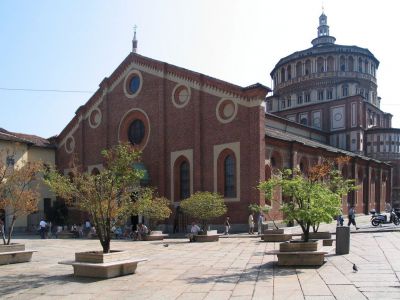
Santa Maria delle Grazie (the Church of Holy Mary of Grace) is a world-famous church and Dominican convent in Milan, included in the UNESCO World Heritage sites list. The Duke of Milan, Francesco I Sforza, ordered the building of Santa Maria delle Grazie in the 15th century. The design of its apse has been attributed to Donato Bramante, who at that time was in the service of the Duchy. While adhering to the overall Gothic style of the convent, he added some Romanesque touches as well.
The church is primarily famous for the mural of The Last Supper (Il Cenacolo Vinciano) found in the refectory of the convent. Created by Leonardo da Vinci for his patron Duke Ludovico Sforza and the Duchess, this 15th-century wall painting was made on a dry wall rather than on wet plaster, and, thus, is not truly a fresco. A fresco cannot be altered as the artist works; therefore, Leonardo decided to paint on the stone wall and then cover it with a sealing layer. The work began to deteriorate a few years after he had finished it. Two early copies of "The Last Supper", thought to be the work of Leonardo's assistant, still exist.
During World War II, on the night of 15 August 1943, an allied aerial bombardment hit the church and the convent. Much of the refectory was destroyed, but some walls survived, including the one holding "The Last Supper", which had been sand-bagged for protection. The preservation works continuously done ever since, and hopefully in the future, are believed to maintain this painting intact for many centuries to come.
Why You Should Visit:
Viewing "The Last Supper" in its own setting will make you feel more appreciative of the single point linear perspective and the 3D effect so cleverly used by Da Vinci.
Tip:
To view "The Last Supper", make sure to book your tickets well in advance on the official website, as they are usually sold out within at least two weeks prior to the sought date.
The church is primarily famous for the mural of The Last Supper (Il Cenacolo Vinciano) found in the refectory of the convent. Created by Leonardo da Vinci for his patron Duke Ludovico Sforza and the Duchess, this 15th-century wall painting was made on a dry wall rather than on wet plaster, and, thus, is not truly a fresco. A fresco cannot be altered as the artist works; therefore, Leonardo decided to paint on the stone wall and then cover it with a sealing layer. The work began to deteriorate a few years after he had finished it. Two early copies of "The Last Supper", thought to be the work of Leonardo's assistant, still exist.
During World War II, on the night of 15 August 1943, an allied aerial bombardment hit the church and the convent. Much of the refectory was destroyed, but some walls survived, including the one holding "The Last Supper", which had been sand-bagged for protection. The preservation works continuously done ever since, and hopefully in the future, are believed to maintain this painting intact for many centuries to come.
Why You Should Visit:
Viewing "The Last Supper" in its own setting will make you feel more appreciative of the single point linear perspective and the 3D effect so cleverly used by Da Vinci.
Tip:
To view "The Last Supper", make sure to book your tickets well in advance on the official website, as they are usually sold out within at least two weeks prior to the sought date.

10) Quartiere Navigli (Navigli District)
Milan's Navigli District is a lively and vibrant area known for its picturesque canals, which were once used to transport goods throughout the city, and which now provide a scenic backdrop for the many bars, restaurants, and cafes that line their banks.
As the city's liveliest neighbourhood, Navigli is particularly popular with young people, and is known for its nightlife, with many bars and clubs staying open until the early hours of the morning. During the day, the area is a hub of activity, with a bustling street market selling everything from vintage clothing to handmade crafts.
Picturesque remnants of the city's ancient past, including the Roman basilica of San Lorenzo, the early-Christian church of Saint Eustorgius, and the 19th-century triumphal arch on Piazza XXIV Maggio, serve as a backdrop to the scene.
A unique blend of history, culture, and contemporary urban living, the Navigli district is a must-visit destination.
As the city's liveliest neighbourhood, Navigli is particularly popular with young people, and is known for its nightlife, with many bars and clubs staying open until the early hours of the morning. During the day, the area is a hub of activity, with a bustling street market selling everything from vintage clothing to handmade crafts.
Picturesque remnants of the city's ancient past, including the Roman basilica of San Lorenzo, the early-Christian church of Saint Eustorgius, and the 19th-century triumphal arch on Piazza XXIV Maggio, serve as a backdrop to the scene.
A unique blend of history, culture, and contemporary urban living, the Navigli district is a must-visit destination.
