Custom Walk in Matera, Italy by thibaultmacleod_c328f created on 2025-04-25
Guide Location: Italy » Matera
Guide Type: Custom Walk
# of Sights: 5
Tour Duration: 1 Hour(s)
Travel Distance: 2 Km or 1.2 Miles
Share Key: ZEMRH
Guide Type: Custom Walk
# of Sights: 5
Tour Duration: 1 Hour(s)
Travel Distance: 2 Km or 1.2 Miles
Share Key: ZEMRH
How It Works
Please retrieve this walk in the GPSmyCity app. Once done, the app will guide you from one tour stop to the next as if you had a personal tour guide. If you created the walk on this website or come to the page via a link, please follow the instructions below to retrieve the walk in the app.
Retrieve This Walk in App
Step 1. Download the app "GPSmyCity: Walks in 1K+ Cities" on Apple App Store or Google Play Store.


Step 2. In the GPSmyCity app, download(or launch) the guide "Matera Map and Walking Tours".
Step 3. Tap the menu button located at upper right corner of the "Walks" screen and select "Retrieve custom walk". Enter the share key: ZEMRH
1) Belvedere Piazzetta Pascoli (Pascoli Square Belvedere)
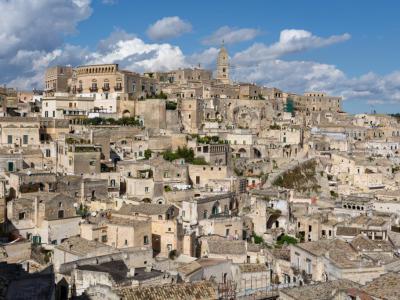
Pascoli Square Belvedere may be small in size, but it has long punched above its weight in Matera’s story. Tucked beside the 17th-century Lanfranchi Palace-once a Dominican seminary, now home to the National Museum of Medieval and Modern Art of Basilicata-it carries the name of poet Giovanni Pascoli, who briefly taught here in the 19th century. For a man of words, this outlook would have needed none: the view alone speaks volumes.
From the parapet, the Sassi districts stretch out in layers-Sasso Caveoso and Sasso Barisano clinging to the limestone cliffs, with the Gravina gorge plunging below and the Murgia plateau beyond. The cathedral rises on the ridge, rupestrian churches mark the cliffs, and at night the caves glitter with light, as if Matera itself were a constellation set into stone.
The square has also doubled as a stage for art and reflection. In 2011, Japanese sculptor Kengiro Azuma placed The Drop here, a bronze monument nearly three meters tall, a reminder that water has always been the lifeblood of the city carved into rock. Long before that, in the 17th and 18th centuries, this terrace was part of Matera’s baroque expansion, linking the civic quarter with the ancient cave districts below. By the 20th century, it had settled into the role of gathering ground, alive with markets, concerts, and public life.
Today, Pascoli Plaza balances past and present. It frames one of Matera’s most photographed panoramas while remaining a lived-in square, where everyday chatter mixes with centuries of history beneath the open sky.
From the parapet, the Sassi districts stretch out in layers-Sasso Caveoso and Sasso Barisano clinging to the limestone cliffs, with the Gravina gorge plunging below and the Murgia plateau beyond. The cathedral rises on the ridge, rupestrian churches mark the cliffs, and at night the caves glitter with light, as if Matera itself were a constellation set into stone.
The square has also doubled as a stage for art and reflection. In 2011, Japanese sculptor Kengiro Azuma placed The Drop here, a bronze monument nearly three meters tall, a reminder that water has always been the lifeblood of the city carved into rock. Long before that, in the 17th and 18th centuries, this terrace was part of Matera’s baroque expansion, linking the civic quarter with the ancient cave districts below. By the 20th century, it had settled into the role of gathering ground, alive with markets, concerts, and public life.
Today, Pascoli Plaza balances past and present. It frames one of Matera’s most photographed panoramas while remaining a lived-in square, where everyday chatter mixes with centuries of history beneath the open sky.

2) Chiesa Rupestre di San Pietro Barisano (Rupestrian Church of St. Peter Barisano)
The Church of San Pietro Barisano was originally called San Pietro de Veteribus ("venerable, old"). It is the largest rock church in the city of Matera. The church has been modified more than once over the ages. The first expansion took place between the 15th and 16th centuries.
In the first expansion of the church, side chapels, were installed. Only part of the chapel remains, behind the second altar in the right aisle. There are frescoes of Saint Catherine of Alexandria, the Annunciation, Saints Canio, Saint Augustine, Saint Eustachio, and Saint Vito.
The second renovation gave the church a three-nave plan, a new facade, and an underground room called the "Putridarium," a place for the "draining" of the corpses. This funeral practice was reserved for priests. The drained bodies were dressed in liturgical robes and seated in niches in the tuff walls.
Entering the right aisle, one will find the altar of Saint Joseph, missing its altarpiece, stolen in 1977; the altar of Madonna della Consolazione, with tuff images of Madonna and Child, angels and saints; and the altar of the Blessed Sacrament with its floor of decorated majolica tiles.
The left aisle features the altar of the gold leaf Most Holy Crucifix, the altar of the Annunciation, and the altar of Saint Mary Magdalene. At the end of the aisle is the "Sancta Sanctorum," the storage room for liturgical vestments, furnishings, and relics of saints. There are frescoes of the Madonna and Child and Saint Donato the Bishop.
In the first expansion of the church, side chapels, were installed. Only part of the chapel remains, behind the second altar in the right aisle. There are frescoes of Saint Catherine of Alexandria, the Annunciation, Saints Canio, Saint Augustine, Saint Eustachio, and Saint Vito.
The second renovation gave the church a three-nave plan, a new facade, and an underground room called the "Putridarium," a place for the "draining" of the corpses. This funeral practice was reserved for priests. The drained bodies were dressed in liturgical robes and seated in niches in the tuff walls.
Entering the right aisle, one will find the altar of Saint Joseph, missing its altarpiece, stolen in 1977; the altar of Madonna della Consolazione, with tuff images of Madonna and Child, angels and saints; and the altar of the Blessed Sacrament with its floor of decorated majolica tiles.
The left aisle features the altar of the gold leaf Most Holy Crucifix, the altar of the Annunciation, and the altar of Saint Mary Magdalene. At the end of the aisle is the "Sancta Sanctorum," the storage room for liturgical vestments, furnishings, and relics of saints. There are frescoes of the Madonna and Child and Saint Donato the Bishop.

3) Cattedrale di Matera (Matera Cathedral) (must see)
The Matera Cathedral crowns the city from the highest ridge between the Sassi districts, a position that has made it both a landmark and a watchful presence for nearly eight centuries. Work began around 1230, on the ruins of a Benedictine monastery, and by 1270 the new cathedral was ready-first dedicated to Saint Eustace, then later to the Dark-skinned Madonna, who became Matera’s most beloved protector. From the outside, the building still carries the clean lines of the 13th century, while the interior reveals a far more layered history of alteration and embellishment.
Look closely at the façade: a rose window with sixteen rays bursts out from the stone, framed above by Archangel Michael trampling a dragon. Below, an Atlas figure strains under the weight of the design, while a row of lemons-twelve in all-quietly symbolize the apostles. Lions, saints, and prophets guard the portal, while a 170-foot bell tower rises beside it, visible from every corner of the Sassi.
Step inside and the mood shifts. A Byzantine fresco of the Dark-skinned Madonna survives from the 13th century, while later centuries gilded the space with painted ceilings, elaborate plasterwork, and golden altars. The wooden choir stalls, Persio’s Nativity, and Santoro’s paintings all speak to Matera’s artistic lineage. The Chapel of the Annunciation, with its coffered ceiling and sculpted Virgin, completes the ensemble.
Neglect, earthquakes, and restorations have all left their trace, but since reopening in 2016 the cathedral has returned to its role as both parish church and symbol of civic pride. From its terrace, the view sweeps down over the Sassi, making the cathedral as much a vantage point on Matera’s history as it is a place of worship.
Look closely at the façade: a rose window with sixteen rays bursts out from the stone, framed above by Archangel Michael trampling a dragon. Below, an Atlas figure strains under the weight of the design, while a row of lemons-twelve in all-quietly symbolize the apostles. Lions, saints, and prophets guard the portal, while a 170-foot bell tower rises beside it, visible from every corner of the Sassi.
Step inside and the mood shifts. A Byzantine fresco of the Dark-skinned Madonna survives from the 13th century, while later centuries gilded the space with painted ceilings, elaborate plasterwork, and golden altars. The wooden choir stalls, Persio’s Nativity, and Santoro’s paintings all speak to Matera’s artistic lineage. The Chapel of the Annunciation, with its coffered ceiling and sculpted Virgin, completes the ensemble.
Neglect, earthquakes, and restorations have all left their trace, but since reopening in 2016 the cathedral has returned to its role as both parish church and symbol of civic pride. From its terrace, the view sweeps down over the Sassi, making the cathedral as much a vantage point on Matera’s history as it is a place of worship.
4) Sassi di Matera (Stones of Matera Districts)
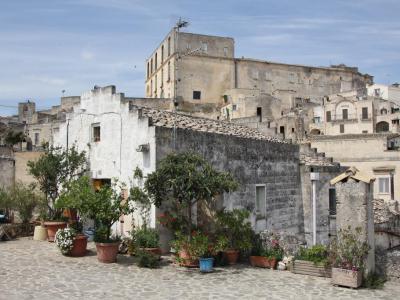
The Sassi di Matera, or “Stones of Matera,” form the most iconic and historic districts of the city, carved into the limestone cliffs of southern Italy’s Basilicata region. These ancient cave dwellings, some dating back to the Paleolithic period, are considered among the earliest examples of human settlement in Italy. Over the centuries, the caves evolved from simple shelters into a complex urban environment, complete with homes, chapels, cisterns, and even underground streets. Recognized as a UNESCO World Heritage Site in 1993, the Sassi stand today as a striking example of how humans adapted architecture to the natural landscape.
The Sassi are divided into two main areas: Sasso Caveoso and Sasso Barisano. Sasso Caveoso preserves the more traditional cave-dwelling structures, where visitors can see how families lived in rock-hewn houses until the mid-20th century. In contrast, Sasso Barisano developed into a district with more elaborate façades and palazzi built over the caves, reflecting centuries of social and architectural transformation. Both districts are interwoven with narrow stairways, winding alleys, and terraces that open to panoramic views of the Gravina canyon, creating a cityscape unlike any other in Europe.
Exploring the Sassi today offers a unique cultural experience. Many of the former cave homes have been restored and repurposed as museums, boutique hotels, artisan shops, and restaurants, allowing visitors to witness the balance between preservation and modern use. Walking through the labyrinthine streets, travelers encounter rock-hewn churches decorated with medieval frescoes, quiet courtyards, and striking viewpoints. The Sassi di Matera embody both history and resilience, offering an unforgettable journey into Italy’s ancient past while showcasing the city’s revival as a vibrant cultural destination.
The Sassi are divided into two main areas: Sasso Caveoso and Sasso Barisano. Sasso Caveoso preserves the more traditional cave-dwelling structures, where visitors can see how families lived in rock-hewn houses until the mid-20th century. In contrast, Sasso Barisano developed into a district with more elaborate façades and palazzi built over the caves, reflecting centuries of social and architectural transformation. Both districts are interwoven with narrow stairways, winding alleys, and terraces that open to panoramic views of the Gravina canyon, creating a cityscape unlike any other in Europe.
Exploring the Sassi today offers a unique cultural experience. Many of the former cave homes have been restored and repurposed as museums, boutique hotels, artisan shops, and restaurants, allowing visitors to witness the balance between preservation and modern use. Walking through the labyrinthine streets, travelers encounter rock-hewn churches decorated with medieval frescoes, quiet courtyards, and striking viewpoints. The Sassi di Matera embody both history and resilience, offering an unforgettable journey into Italy’s ancient past while showcasing the city’s revival as a vibrant cultural destination.
5) Piazza San Pietro Caveoso (San Pietro Caveoso Square)
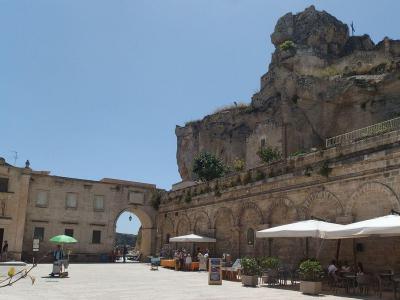
Saint Pietro Caveoso Square feels like a stage set where Matera’s history and landscape perform together. The square takes its name from the Church of Saints Peter and Paul, built in the 13th century and later dressed up with a Baroque outside and towers. From its perch on the cliff edge, the church commands attention, with the gorge of the Gravina river and the rocky plateau of the Murgia rolling away behind it. The result is a setting where stone, faith, and landscape intertwine.
For centuries, this square carried the rhythm of local life. Religious processions wound their way through it, markets filled the open space, and families from the cave dwellings of Sasso Caveoso mixed with those crossing in from the plateau. The surrounding rock-carved homes and palaces form a kind of natural amphitheater, pressing close around the plaza while opening dramatically toward the ravine. Walk a little further and paths lead into lamias-plain cave houses once shared by farmers, animals, and tools. These were the same dwellings branded as the “shame of Italy” in the 20th century, abandoned in poverty but still haunting in their raw authenticity.
Today, the square serves as both a gathering point and a vantage point. From here you can step toward rock churches like the Madonna of Idris or Saint Lucia alle Malve, or simply pause to take in the layered view of Matera’s past carved into stone. By day, the square is a hub for visitors; by night, the unlit alleys beyond make it better left to guided walks. Saint Pietro Caveoso Square remains a place where Matera’s contrasts-sacred and domestic, ruin and revival-are laid bare in one unforgettable panorama.
For centuries, this square carried the rhythm of local life. Religious processions wound their way through it, markets filled the open space, and families from the cave dwellings of Sasso Caveoso mixed with those crossing in from the plateau. The surrounding rock-carved homes and palaces form a kind of natural amphitheater, pressing close around the plaza while opening dramatically toward the ravine. Walk a little further and paths lead into lamias-plain cave houses once shared by farmers, animals, and tools. These were the same dwellings branded as the “shame of Italy” in the 20th century, abandoned in poverty but still haunting in their raw authenticity.
Today, the square serves as both a gathering point and a vantage point. From here you can step toward rock churches like the Madonna of Idris or Saint Lucia alle Malve, or simply pause to take in the layered view of Matera’s past carved into stone. By day, the square is a hub for visitors; by night, the unlit alleys beyond make it better left to guided walks. Saint Pietro Caveoso Square remains a place where Matera’s contrasts-sacred and domestic, ruin and revival-are laid bare in one unforgettable panorama.
