Custom Walk in Rio de Janeiro, Brazil by jmapesey_c3262 created on 2025-03-27
Guide Location: Brazil » Rio de Janeiro
Guide Type: Custom Walk
# of Sights: 7
Tour Duration: 2 Hour(s)
Travel Distance: 3.9 Km or 2.4 Miles
Share Key: XJNDL
Guide Type: Custom Walk
# of Sights: 7
Tour Duration: 2 Hour(s)
Travel Distance: 3.9 Km or 2.4 Miles
Share Key: XJNDL
How It Works
Please retrieve this walk in the GPSmyCity app. Once done, the app will guide you from one tour stop to the next as if you had a personal tour guide. If you created the walk on this website or come to the page via a link, please follow the instructions below to retrieve the walk in the app.
Retrieve This Walk in App
Step 1. Download the app "GPSmyCity: Walks in 1K+ Cities" on Apple App Store or Google Play Store.


Step 2. In the GPSmyCity app, download(or launch) the guide "Rio de Janeiro Map and Walking Tours".
Step 3. Tap the menu button located at upper right corner of the "Walks" screen and select "Retrieve custom walk". Enter the share key: XJNDL
1) Escadaria Selarón (Selarón Steps) (must see)
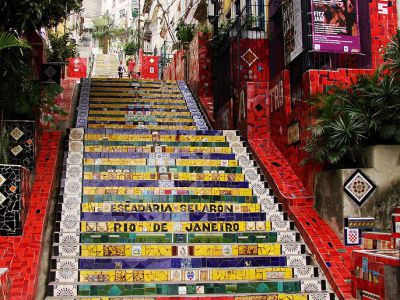
Escadaria Selarón, renowned worldwide, comprises a remarkable set of stairs that stretch between Joaquim Silva Street and Pinto Martins Street, spanning both the Lapa and Santa Teresa neighborhoods of Rio de Janeiro. These steps are the creative masterpiece of Jorge Selarón, an artist originally from Chile, who referred to it as "my tribute to the Brazilian people." His endeavor began in 1990 with the intention of rejuvenating the deteriorated steps in front of his home. Initially, it was a secondary project compared to his primary passion, painting, but it quickly evolved into an all-consuming obsession. Selarón himself regarded this work as "never complete" and asserted that "This eccentric and one-of-a-kind dream will only conclude on the day of my demise."
Initially, Selarón sourced tiles for this project from various construction sites and heaps of discarded materials on the streets of Rio. However, in subsequent years, a significant portion of the tiles was contributed by visitors from across the globe. In total, there are 215 steps spanning a length of 125 meters, adorned with over 2,000 tiles representing more than 60 different countries. Among these 2,000+ tiles, roughly 300 were meticulously hand-painted by Selarón himself, featuring an image of a pregnant African woman. Selarón remained reticent about this imagery, merely commenting that it pertained to a "personal issue from my past."
Why You Should Visit:
Not only are the 215 steps a dedication to the Brazilian people but to all who bought tiles from other countries and cities. Find yours!
The story of Selarón's 20-year project just adds to the fun of exploring the plethora of beautiful and/or interesting tiles.
Tip:
If you want your photo taken sitting on steps, you might have to wait a while. Try to arrive early or, at the least, go a few flights up where very few are waiting.
The neighborhood looks a bit unsafe so if you go make sure you don't show off your belongings too much (after dark it's a no-go area!).
Initially, Selarón sourced tiles for this project from various construction sites and heaps of discarded materials on the streets of Rio. However, in subsequent years, a significant portion of the tiles was contributed by visitors from across the globe. In total, there are 215 steps spanning a length of 125 meters, adorned with over 2,000 tiles representing more than 60 different countries. Among these 2,000+ tiles, roughly 300 were meticulously hand-painted by Selarón himself, featuring an image of a pregnant African woman. Selarón remained reticent about this imagery, merely commenting that it pertained to a "personal issue from my past."
Why You Should Visit:
Not only are the 215 steps a dedication to the Brazilian people but to all who bought tiles from other countries and cities. Find yours!
The story of Selarón's 20-year project just adds to the fun of exploring the plethora of beautiful and/or interesting tiles.
Tip:
If you want your photo taken sitting on steps, you might have to wait a while. Try to arrive early or, at the least, go a few flights up where very few are waiting.
The neighborhood looks a bit unsafe so if you go make sure you don't show off your belongings too much (after dark it's a no-go area!).
2) Arcos da Lapa
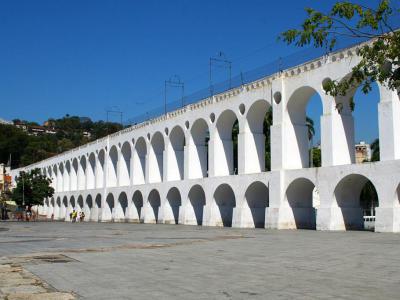
The Arcos da Lapa stands as a historical aqueduct located in Rio de Janeiro. Its construction took place during the mid-18th century with the primary purpose of providing the city's inhabitants with a supply of fresh water from the Carioca River. It serves as a prime example of colonial architecture and engineering.
Situated in the heart of the city within the Lapa neighborhood, the Arcos da Lapa has played a significant role in the region since the late 19th century.
In Rio's early history, the city lacked clean water, so plans began in 1602 to build a canal system bringing water from the Carioca River source on Santa Teresa hill. In 1744, Governor Gomes Freire de Andrade commissioned a larger aqueduct, inspired by Portugal's Águas Livres Aqueduct, which was completed in 1750.
The most striking feature of the aqueduct is the section that links the Santa Teresa and Santo Antônio hills in what is now the Lapa neighborhood. This segment spans 270 meters and comprises two levels of imposing arches, totaling 42 arches in all, with a maximum height of 17.6 meters.
At the close of the 19th century, the aqueduct was taken out of service as alternative water supply methods for Rio were developed. In 1896, the structure was repurposed to serve as a viaduct for a tram line, known as the Santa Teresa Tramway (Bonde de Santa Teresa), which facilitates transportation between the city center and the hilly Santa Teresa neighborhood. This picturesque tram ride has since become a popular attraction for both locals and tourists.
Why You Should Visit:
This is the place to go at night on the weekends! Lots of fun, lots and lots of performers, dancers, vendors and bars, and a great atmosphere. Worth checking out at least once.
Tip:
There are some great happening bars with amazing local music; check out specific days to catch attractions like Samba nights.
Also make sure you visit the Escadaria Selarón ('Selaron Steps'), which are very pretty and just a 10-minute walk away.
Situated in the heart of the city within the Lapa neighborhood, the Arcos da Lapa has played a significant role in the region since the late 19th century.
In Rio's early history, the city lacked clean water, so plans began in 1602 to build a canal system bringing water from the Carioca River source on Santa Teresa hill. In 1744, Governor Gomes Freire de Andrade commissioned a larger aqueduct, inspired by Portugal's Águas Livres Aqueduct, which was completed in 1750.
The most striking feature of the aqueduct is the section that links the Santa Teresa and Santo Antônio hills in what is now the Lapa neighborhood. This segment spans 270 meters and comprises two levels of imposing arches, totaling 42 arches in all, with a maximum height of 17.6 meters.
At the close of the 19th century, the aqueduct was taken out of service as alternative water supply methods for Rio were developed. In 1896, the structure was repurposed to serve as a viaduct for a tram line, known as the Santa Teresa Tramway (Bonde de Santa Teresa), which facilitates transportation between the city center and the hilly Santa Teresa neighborhood. This picturesque tram ride has since become a popular attraction for both locals and tourists.
Why You Should Visit:
This is the place to go at night on the weekends! Lots of fun, lots and lots of performers, dancers, vendors and bars, and a great atmosphere. Worth checking out at least once.
Tip:
There are some great happening bars with amazing local music; check out specific days to catch attractions like Samba nights.
Also make sure you visit the Escadaria Selarón ('Selaron Steps'), which are very pretty and just a 10-minute walk away.

3) Catedral Metropolitana de São Sebastião
The Metropolitan Cathedral of Saint Sebastian, also known as the Metropolitan Cathedral of Rio de Janeiro, serves as the headquarters for the Roman Catholic Archdiocese of São Sebastião do Rio de Janeiro. It is where the Metropolitan Archbishops of Rio de Janeiro carry out their religious duties, and it is dedicated to Saint Sebastian, the patron saint of the city.
Designed by Edgar de Oliveira da Fonseca, the cathedral boasts a modern architectural style inspired by Mayan pyramids. The current cathedral was constructed between 1964 and 1979, replacing a series of churches that had previously served as cathedrals since 1676. The most recent and notable of these was the Church of Our Lady of Mount Carmel of the Ancient See, now referred to as the Old Cathedral, which was built in the 18th century and declared Rio's cathedral in the early 19th century.
The New Cathedral, as it is sometimes called, is situated in the city center. It has a distinctive conical shape with an internal diameter of 96 meters (315 feet), an external diameter of 106 meters, and an overall height of 75 meters (246 feet). The interior of the cathedral covers 8,000 square meters and provides seating for 5,000 people, with the ability to accommodate up to 20,000 individuals when standing. The cathedral's four rectangular stained glass windows reach an impressive height of 64 meters (210 feet), extending from the floor to the ceiling.
The interior design of the cathedral was created by Father Paulo Lachen Maier, while the sculptures were crafted by Humberto Cozzo. Additionally, the Chapel of the Blessed Sacrament features two candelabras created by Niccola Zanotto.
Why You Should Visit:
Majestic on the inside, free of charge, and with very minimal crowds. The massive coloured glass windows are as tall as the church itself and are beautiful beyond belief.
Tip:
Try to go during the middle of the day since the church relies on natural illumination and going earlier / later can leave it dark inside.
As the location is so close to Cinelândia and all of its attractions, you can do both on the same day.
Designed by Edgar de Oliveira da Fonseca, the cathedral boasts a modern architectural style inspired by Mayan pyramids. The current cathedral was constructed between 1964 and 1979, replacing a series of churches that had previously served as cathedrals since 1676. The most recent and notable of these was the Church of Our Lady of Mount Carmel of the Ancient See, now referred to as the Old Cathedral, which was built in the 18th century and declared Rio's cathedral in the early 19th century.
The New Cathedral, as it is sometimes called, is situated in the city center. It has a distinctive conical shape with an internal diameter of 96 meters (315 feet), an external diameter of 106 meters, and an overall height of 75 meters (246 feet). The interior of the cathedral covers 8,000 square meters and provides seating for 5,000 people, with the ability to accommodate up to 20,000 individuals when standing. The cathedral's four rectangular stained glass windows reach an impressive height of 64 meters (210 feet), extending from the floor to the ceiling.
The interior design of the cathedral was created by Father Paulo Lachen Maier, while the sculptures were crafted by Humberto Cozzo. Additionally, the Chapel of the Blessed Sacrament features two candelabras created by Niccola Zanotto.
Why You Should Visit:
Majestic on the inside, free of charge, and with very minimal crowds. The massive coloured glass windows are as tall as the church itself and are beautiful beyond belief.
Tip:
Try to go during the middle of the day since the church relies on natural illumination and going earlier / later can leave it dark inside.
As the location is so close to Cinelândia and all of its attractions, you can do both on the same day.
4) Royal Portuguese Cabinet of Reading
The Royal Portuguese Cabinet of Reading is revered as one of the most beautiful libraries in the world. It has the most expansive collection of Portuguese literature outside Portugal.
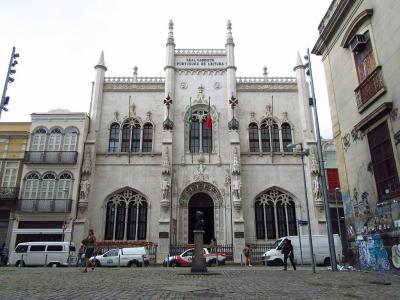
The building was finished in 1887 in the Neo-Manueline style. This design is reminiscent of the Gothic-Renaissance style popular during the reign of King Manuel (from 1495-1521). During this time, the Portuguese were beginning to discover the New World.
Emperor Pedro II laid the cornerstone in 1880, and Imperial Princess Isabel inaugurated the building in 1887. The Jerónimos Monastery inspired the facade in Lisbon. It was made from local stone in Lisbon and then transferred by ship to Rio de Janeiro. Four statues decorate the exterior. They represent Prince Henry the Navigator, Vasco da Gama, Luís de Camões, and Pedro Álvares Cabral.
The interior is spectacular, with the book collection towering three stories tall around the reading area. The reading room features a stained-glass skylight with a cast iron frame, allowing natural light to illuminate the library. An elegant chandelier hangs from the Reading Room's ceiling. A statue of Pedro Álvares Cabral, credited as the European discoverer of Brazil, stands in the reading room.
The building was finished in 1887 in the Neo-Manueline style. This design is reminiscent of the Gothic-Renaissance style popular during the reign of King Manuel (from 1495-1521). During this time, the Portuguese were beginning to discover the New World.
Emperor Pedro II laid the cornerstone in 1880, and Imperial Princess Isabel inaugurated the building in 1887. The Jerónimos Monastery inspired the facade in Lisbon. It was made from local stone in Lisbon and then transferred by ship to Rio de Janeiro. Four statues decorate the exterior. They represent Prince Henry the Navigator, Vasco da Gama, Luís de Camões, and Pedro Álvares Cabral.
The interior is spectacular, with the book collection towering three stories tall around the reading area. The reading room features a stained-glass skylight with a cast iron frame, allowing natural light to illuminate the library. An elegant chandelier hangs from the Reading Room's ceiling. A statue of Pedro Álvares Cabral, credited as the European discoverer of Brazil, stands in the reading room.

5) Confeitaria Colombo (Colombo Confectionery) (must see)
Confeitaria Colombo has been named one of the most beautiful cafes in the world. It was founded in 1894, and its architecture was inspired by European cafes. The design represents the belle epoque, or beautiful age before World War I.
In the early 20th century, the interior was renovated to emulate the trendy Art Nouveau style. Artisan Antonio Borsoi painstakingly handcrafted the wooden furniture used in the interior. An upper floor and tearoom were added in 1922. The ceiling features a gorgeous stained glass skylight from France. The towering mirrors were imported from Belgium and feature jacaranda frames. The Portuguese tiles are gorgeous.
The Confeitaria Colombo has long been a meeting place for important discussions. Heads of state and royalty such as Queen Elizabeth II of England, King Albert I of Belgium, and Brazillian Presidents Getulio Vargas and Juscelino Kubitschek have visited the Confeitaria Colombo.
It also served as a gathering place for Brazilian artists, musicians, and writers. Composer, conductor, and musicians Villa-Lobos, Chiquinha Gonzaga, and writers Lima Barreto and José do Patrocínio would often meet here.
The cafe remains committed to its elegant history and serves fabulous coffee and tea. Breakfast, brunch, lunch, and desserts are also offered.
Why You Should Visit:
Feast your eyes on the stunning interior while enjoying a memorable beverage. There's no better place to sit down for a cup of coffee or tea while enjoying some people watching. This cafe sees the whos-who of Rio's social scene, from the city's working people to the rich and powerful.
Tips:
Try the brigadeiro for dessert. This delicious Brazillian sweet is made with condensed milk and chocolate and is sure to delight!
In the early 20th century, the interior was renovated to emulate the trendy Art Nouveau style. Artisan Antonio Borsoi painstakingly handcrafted the wooden furniture used in the interior. An upper floor and tearoom were added in 1922. The ceiling features a gorgeous stained glass skylight from France. The towering mirrors were imported from Belgium and feature jacaranda frames. The Portuguese tiles are gorgeous.
The Confeitaria Colombo has long been a meeting place for important discussions. Heads of state and royalty such as Queen Elizabeth II of England, King Albert I of Belgium, and Brazillian Presidents Getulio Vargas and Juscelino Kubitschek have visited the Confeitaria Colombo.
It also served as a gathering place for Brazilian artists, musicians, and writers. Composer, conductor, and musicians Villa-Lobos, Chiquinha Gonzaga, and writers Lima Barreto and José do Patrocínio would often meet here.
The cafe remains committed to its elegant history and serves fabulous coffee and tea. Breakfast, brunch, lunch, and desserts are also offered.
Why You Should Visit:
Feast your eyes on the stunning interior while enjoying a memorable beverage. There's no better place to sit down for a cup of coffee or tea while enjoying some people watching. This cafe sees the whos-who of Rio's social scene, from the city's working people to the rich and powerful.
Tips:
Try the brigadeiro for dessert. This delicious Brazillian sweet is made with condensed milk and chocolate and is sure to delight!

6) Theatro Municipal (Municipal Theatre) (must see)
The Theatro Municipal of Rio de Janeiro was inaugurated in 1909. Located in Cinelandia Square, this beautiful building serves as an opera house and theatre. It is one of the most important theatres in Brazil. Today, most of the productions focus on classical music and ballet performances.
The architectural design was inspired by the Palais Garnier, which was built to house the Paris Opera in France. Brazillian painters and sculptors decorated the Theatro Municipal with fabulous appointments. The exterior has inscriptions bearing the names of classic Brazillian and European artists. A gilded bird watches over the theatre from atop an embellished dome.
The interior is equally spectacular. You'll find priceless artworks, paintings, and sculptures. Eliseu Visconti exquisitely painted the foyer ceiling, nave ceiling, and the frieze on the proscenium.
Tip:
Guided multilingual tours lasting 45 mins are offered Tue-Fri (12pm/2:30pm/4pm) and on Sat (11am/12pm/1pm/4pm). Call ahead to confirm availability of an English-speaking guide. If you want to take the guided tour, try to get there at 10am sharp. Even if you want the 1pm tour, tickets get sold out pretty fast, since the place only supports up to 50 people.
The architectural design was inspired by the Palais Garnier, which was built to house the Paris Opera in France. Brazillian painters and sculptors decorated the Theatro Municipal with fabulous appointments. The exterior has inscriptions bearing the names of classic Brazillian and European artists. A gilded bird watches over the theatre from atop an embellished dome.
The interior is equally spectacular. You'll find priceless artworks, paintings, and sculptures. Eliseu Visconti exquisitely painted the foyer ceiling, nave ceiling, and the frieze on the proscenium.
Tip:
Guided multilingual tours lasting 45 mins are offered Tue-Fri (12pm/2:30pm/4pm) and on Sat (11am/12pm/1pm/4pm). Call ahead to confirm availability of an English-speaking guide. If you want to take the guided tour, try to get there at 10am sharp. Even if you want the 1pm tour, tickets get sold out pretty fast, since the place only supports up to 50 people.

7) Cinelandia Square
Officially named Praça Floriano Peixoto, after Brazil's second president, this area of town is more commonly called Cinelandia Square. Around the spacious public square, you'll find a variety of historic landmark buildings, like the opera house and theater.
Originally, this square was simply the site of the Ajuda Convent, built in 1750. When Rio de Janeiro was named the capital of Brazil in the early 20th century, the square began to take shape. Several grand cinemas stood in the square. While most of the cinemas have closed, the Cinelandia (cinema land) name remains.
Important and architecturally interesting buildings in the square are the Teatro Municipal, the Palacio Pedro Ernesto, the Biblioteca Nacional, and the Tribunal Superior.
Visitors will find an impressive statue of Marshal Floriano Peixoto, Brazil's second president, for whom the square is officially named. This bronze statue was designed by Eduardo Sa and commemorated in 1910. The statue incorporates a scene portraying different events from Brazilian history.
A 19th-century Brazilian composer, Carlos Gomes, is also immortalized in a bronze statue.
Today, the square has theatres, museums, and nearby restaurants and bars. It's a lively place where locals often hold peaceful gatherings.
Originally, this square was simply the site of the Ajuda Convent, built in 1750. When Rio de Janeiro was named the capital of Brazil in the early 20th century, the square began to take shape. Several grand cinemas stood in the square. While most of the cinemas have closed, the Cinelandia (cinema land) name remains.
Important and architecturally interesting buildings in the square are the Teatro Municipal, the Palacio Pedro Ernesto, the Biblioteca Nacional, and the Tribunal Superior.
Visitors will find an impressive statue of Marshal Floriano Peixoto, Brazil's second president, for whom the square is officially named. This bronze statue was designed by Eduardo Sa and commemorated in 1910. The statue incorporates a scene portraying different events from Brazilian history.
A 19th-century Brazilian composer, Carlos Gomes, is also immortalized in a bronze statue.
Today, the square has theatres, museums, and nearby restaurants and bars. It's a lively place where locals often hold peaceful gatherings.
